Thursday, June 26, 2008

India, Karuna, and advocacy work

The Karuna Trust is the FWBO’s largest and most successful fundraising charity, sending well over UK £1,000,000/year to a wide variety of projects in India, Nepal, Bangladesh, and Tibet. In recent years their focus has shifted from the approach of ‘Aid for India’ (their original name!) to encouraging projects that specialise in helping India’s disadvantaged peoples effectively and peacefully access their legal entitlements.

These naturally include India’s more than 200 million Dalits and Tribal people, from whom come the vast majority of India’s Buddhists, including of course members of the TBMSG. While India as a whole has become increasingly prosperous over the last decade, discrimination of all sorts is still rife, and especially discrimination based on the age-old and scripturally-sanctioned caste system.

Two such projects which have been funded by Karuna are the 'Dalit Rights Initiative' (a part of India’s ‘Human Rights Law Network') and ‘Social Jurist’. Both have hundreds, if not thousands, of stories to tell, and we have posted a few of these on the FWBO News Features page.

Ananta from Karuna comments “In spite of the harrowing content, the stories move towards a 'happy ending' which I found uplifting not least because our efforts are supporting this work. The full list of cases is available on their websites if you want to read more”.

There is a growing trend of ‘advocacy’ work that often uses the internet – Karuna’s attention was recently drawn to Meena Kandasamy’s blog, a 24-year–old Tamil woman who is self-confessedly “obsessed with revolutionary Dr.Ambedkar’s message of caste annihilation”. Her blog describes the punishments meted out to ‘dangerous Dalit women’ seen as witches by caste Hindus.

She ends with words that could almost have been written of the ‘witches’ and witchcraft trials of Briain and the US in earlier centuries: “…in witch-hunting, the victims are also single (read widowed/ deserted/ divorced) women of a certain age who are no longer burdened with reproductive duties. The word ‘witch’ is thrust on these ‘dangerous’ women who asserted their entitlement to rights and thus challenged patriarchal and caste supremacist diktats. Dalit or Adivasi (Tribal) women who dared to contest elections and directly challenged the political power of the landed caste-Hindus have been labeled hags. They have been accused of exercising black magic when in fact they have only been exercising their fundamental rights. Witchcraft, when used by brutal caste-Hindus in the modern context, has come to signify women’s resistance to oppression, and the price they have paid for it”.

Click here to read some of the full stories from the 'Dalit Rights Initiative' and ‘Social Jurist’ projects.

You can donate to Karuna via their website, www.karuna.org.

Labels: , , ,

Thursday, June 19, 2008

Hearing The Cries Of The World

Coming up soon at Taraloka, the FWBO’s retreat centre in Shropshire, is a new retreat ‘Making A Difference’. It’s based on ‘The Work that Reconnects’ - a powerful set of exercises that enable us to look clearly at the state of world around us and our emotional responses to it. Doing this opens the way to us, in turn, taking our part in creating an ethical and sustainable future. It was developed by the American Buddhist Joanna Macy and has been taken up by a number of Order Members, several of whom have attended Joanna’s training retreats both in the US and Britain.
‘Making A Difference’ will be led by three of these: Parami, Akuppa and Maitrisara. It takes place on the 20th to 27th June and the following weekend, 27th to 29th June, will be specifically for people who may like to facilitate this work within the F/WBO, creating a working network within our movement.

Parami especially has had contact with Joanna Macy, and writes “What fires me and seems to be very inspiring to people is an increasing exploration and understanding of the links between the WTR and the Dharma and - perhaps especially - how the two can work together to form a community of people dedicated to working effectively in our troubled world but from a place of inner peace and meditative awareness. Applied Bodhisattva Ideal in other words. Conditionality in action”.

She goes on to say “In April I attended a weekend in Bath for people facilitating the WTR in the UK. Joanna and Fran Macy were there. Joanna had just been speaking in Findhorn and had asked a couple of the people that she has worked with for many years to organise a get-together of facilitators. I was able to go along and was able to catch up with Joanna and talk through a few things. She was, as always, very excited to hear about the developments of the WTR within the F/WBO. Although she is not coming on the retreat in June she wanted to reiterate her confidence in our working with the WTR and she wanted us to know that we have her "deepest blessings". She would love to hear from me how the retreat goes and also wants me to keep in touch with her more generally.

“On the topic of the retreat itself, I feel excited about what we might do and inspired to have the chance to go more deeply into the dharmic base of our working with the WTR as a community. I have a strong interest in using systems theory to explore how open a community our community is. I would greatly enjoy co-creating ways of being a more effective force for good.

“I think, as a community, we have such a lot going for us. Of course, there is much work to be done in the face of grave and dangerous challenges in the world today. I think forming community is a part of the creative response to those challenges and I hope this retreat can play a part in strengthening our community as a force for good in the world”.

Labels: ,

Wednesday, June 11, 2008

A Right-Livelihood Land Project in the North East (UK)

An aerial photo of Buddhafield's new land at Frog Mill, in the Dartmoor National ParkA group is forming in the FWBO's Newcastle Sangha to explore the development of a new land-based community and work project informed by the Dharma. The instigator of this group, Andy Parkes, writes:

“What do I mean by ‘A Right-Livelihood Land Project’? And he answers –

“A group of people brought together by specific common ideals, particularly:
• Dharma (movement towards an integrated lifestyle with more harmony between livelihood, community and Buddhist practice)
• Environmental Ethics (movement towards increased ecological sustainability)
• A wish to develop the above, by living and/or working on some land together

“A project like this is group-led and for that reason it is not possible to be specific about its nature. For example, we might buy, borrow or rent land. We might set up a charity, a co-operative or many varying businesses on the land. We may or may not live on the land, and we may each have different levels of input into this project. Personally, I would like to give my attention to the Dharma, growing trees, organic food, greenwood working, music, teaching, building a low-impact dwelling for myself and others, and being part of a community I can give to and receive from. We have different skills and will each bring our own emphasis.

Why ‘A Right-Livelihood Land Project’
“Dharma is precious! It feeds us, and points the way to spiritual freedom. Spiritual development and ecological sustainability require a sustained commitment that is often not understood and resisted by our society. Keeping our ethical precepts, preparing ourselves for practice is more challenging when the way in which we support ourselves is replete with subtle (and sometimes not so subtle) contradictions to our beliefs. Land is precious in as much as, it feeds us and unobstructed access to it can lead to a high degree of practical freedom, resulting in less consumerism, more sharing and a responsible relationship to the earth. With practical freedom comes the ability to develop an integrated lifestyle, in which all of our activities can be conducive to spiritual development (Dharma), supporting ourselves in an ecologically sustainable way, and supporting our Buddhist (Sangha) and local community.

“Initially the group will be about getting to know each other and our interests in light of this project, and to see if and how we want to work together as a group. The timescale for developing this project is over months and years. Consolidating the group may take a long time, so don’t be immediately discouraged if you are interested but feel unprepared.”

If you are interested in the project but live outside Newcastle, please feel free to contact Andy at: andrew.parkes@sunderland.ac.uk

The photograph shows Buddhafield's new land at Frog Mill, in the Dartmoor National Park.

Labels: , , , , ,

Tuesday, May 13, 2008


Gunaketu, chairman of the FWBO’s small centre in Oslo , Norway, has for long been active in the field of environmentally and socially engaged Buddhism. He is soon off to Hanoi in Vietnam to participate in a United Nations’ sponsored conference called “The Buddhist Contribution to building a Just, Democratic and Civil Society: War, Conflict and Healing-A Buddhist perspective” .

It is to take place in Hanoi starting May 13th and FWBO News hopes to present a review of it in due course.

Meanwhile Rijumati continues his “round-the-world-more-or-less-without-flying” travels – and has had a variety of adventures both in the world of TBMSG and on the Buddhist pilgrimage circuit of India. The second collection of excerpts from his letters home has been posted on FWBO News’ Features.

Labels: , , ,

Monday, May 12, 2008

How we can respond to the situation in Burma...

FWBO News readers will be aware of the recent terrible floods in Burma – and of the appallingly inadequate response to them by the country’s military Government.

We are very grateful to Jan McHarry, a mitra from the London Buddhist Centre, for suggesting a very practical and appropriate way we can all respond – donating via the International Burmese Monks Organization, who have linked with internet activists Avaaz to respond to the present crisis. She says “Avaaz is a credible organisation linked to many social justice and environmental campaigns”. Avaaz themselves say -

“Humanitarian relief is urgently needed, but Burma's government could easily delay, divert or misuse any aid. Today (May 7th) the International Burmese Monks Organization, including many leaders of the democracy protests last autumn, launched a new effort to provide relief through Burma's powerful grass roots network of monasteries--the most trusted institutions in the country and currently the only source of housing and support in many devastated communities.

"Click below to help the Burmese people with a donation and see a video appeal to Avaaz from a leader of the monks: https://secure.avaaz.org/en/burma_cyclone/7.php?cl=86627405

“Giving to the monks is a smart, fast way to get aid directly to Burma's people. Governments and international aid organizations are important, but face challenges--they may not be allowed into Burma, or they may be forced to provide aid according to the junta's rules. And most will have to spend large amounts of money just setting up operations in the country. The monks are already on the front lines of the aid effort--housing, feeding, and supporting the victims of the cyclone since the day it struck. The International Burmese Monks Organization will send money directly to each monastery through their own networks, bypassing regime controls.

“The monks are unlikely to receive aid from governments or large humanitarian organizations, but they have a stronger presence and trust among the Burmese people than both. If we all chip in a little bit, we can help them to make a big difference.

"Click here to donate: https://secure.avaaz.org/en/burma_cyclone/7.php?cl=86627405

“With hope, Ricken, Ben, Graziela, Paul, Iain, Veronique, Pascal, Galit and the whole Avaaz team”

PS: Here are some links to more information: To learn more about Avaaz's work to support the Burmese people, click here: http://www.avaaz.org/en/burma_report_back/. For more information about the cyclone, the humanitarian crisis, and the political dimension, see these articles:New York Times: "A Challenge Getting Relief to Myanmar's Remote Areas." 7 May 2008.BBC: "Will Burma's leaders let aid in?" 6 May 2008.India's Economic Times: Indian meteorological department advised junta 48 hours in advance, 6 May 2008.BBC: "Disaster tests Burma's junta." 5 May 2008Times Online: "Aid workers fear Burma cyclone deaths will top 50,000." 6 May 2008.

Labels: ,

Monday, April 28, 2008

Fundraising successes and job opportunties at Karuna

It’s nearly the end of April and 2008 is soon to be 1/3rd gone - and over at the Karuna Trust they’ve been counting their pennies.

Karuna is the FWBO’s most successful fundraising charity: it raises over UK £1.5 million every year for a wide range of Dhamma and social projects in India and elsewhere in South Asia – both inside and outside the FWBO and TBMSG. And they have good news to report – Ādarsha, their Trust fundraiser, tells FWBO News -

“Karuna has raised over £118,000 to date this year from Trusts and Foundations. This money is for a number of specific projects working to tackle caste discrimination, enable women's empowerment and provide educational access for disadvantaged children.

“We were going ask FWBO News to run this story when we crossed the £100,000 mark – then the most recent donation, of £13,000, came in. This is for our women's empowerment project tackling incidents of caste-based violence in a particularly poor region of rural Maharashtra. It’s run by our partner SPMM who do great work with Dalits and Tribal people in India, helping them combat atrocities and discrimination through accessing legal provisions and protecting their statutory entitlements to education and legal protection. You can read some of the latest – and quite shocking - news from this project on Global Giving , an American internet fundraising site that Karuna use. And click here for a fuller list of Karuna’s Global Giving projects.

“This money is of course in addition to the regular donations from Karuna’s network of more than 5,000 donors from all over the UK”.

Karuna Job opportunities
Karuna has grown substantially in recent years, and the Karuna team in London have a number of job opportunities coming up. Check our sister site FWBO Jobs for the details: they represent a great opportunity to get involved if you want to give real practical help to the ‘Dhamma Revolution’ in India.

Labels: , , , ,

Tuesday, April 22, 2008

Getting the Dharma to Work…

Last year some 45 people from around the FWBO came together and held an exploratory weekend looking very broadly at “how to make ‘Team-Based Right Livelihood’ more attractive”. Team-Based Right Livelihood (TBRL for short) has always been a core component of the FWBO’s system of practice, being part of its practice of Right Livelihood, which is of course central in the Buddha’s own Noble Eightfold Path.

Vajragupta has recently written to FWBO News to give us an update -

"We considered all sorts of topics: support, training, spiritual practice, and possible new ventures. All sorts of people came, from old-timers who’d always worked in TBRL, to new people who’d never done so. It was a unique, enjoyable, and effective combination of sangha. It seemed to touch on something people were interested in and wanted to explore more deeply.

“At the same time, one issue that became apparent – for people in all forms of work, not just TBRL – was that “work as a spiritual practice” seemed to have gone somewhat off the boil. In the past we’ve been very strong on the general idea that spiritual transformation will only work if you keep practising all day, and it won’t if your practice only means an hour on the cushion. But perhaps we’ve not developed more specific teachings and practice in this area as much as we might. This is surprising, especially given there are some really talented people involved in our Sangha and working in all sorts of areas (both in Buddhist and non-Buddhist contexts).

“So, this year, in September, we will have another weekend. This time we will look more specifically on “getting the Dharma to work”, and it is open to anyone – Order member or mitra, those working in “traditional” TBRL, those in new Buddhist projects, those working in non-Buddhist contexts. The weekend will include talks and workshops led by a variety of talented and inspired folk, including Saddharaja, Shakyakumara, Subhadramati, and myself. If you know of someone who might be fired-up by this topic, please pass this information onto them".

The dates are Friday 12 to Sunday 14 September; the venue is just outside Birmingham (UK); the cost is £45; and to book, or for more information, contact Vajragupta or phone him on +44 (0)121-447-7427.

Labels: , , ,

Tuesday, April 15, 2008

Moving Sounds annual report

Being a world-wide community, the FWBO is full of diverse people and projects, all more – or less – closely affiliated with “The FWBO”, and, as a result, all more or less well-known among the wider FWBO sangha.

Moving Sounds is an example - they’re a small but innovative ‘Community Interest Company’ run by Keith, Ed, Caspar, and Jo, four mitras from the UK’s Buddhafield and Brighton sanghas. They specialise in music and drama workshops for schools, everything they do carrying a skilfully-delivered social message but also being a lot of fun - a certain Head of Geography is on record as saying "The only way the students could have enjoyed it more is if they had been stuffing their faces with chocolate at the same time!"

Their recently published annual report is full of gems such as the RECYCLED ORCHESTRA, which combines the experience of playing recycled percussion as a group with performance, video, discussion and group activities about waste and climate-change; the ECO SHOW, which presents broader ecological issues in a fun and entertaining way using theatre, clowning, plenty of music and different characters to explore topics including energy use, global foot printing, oil consumption, and alternative energy sources. They’ve just commissioned a local artist to make a pair of giant feet (for the USA, we wonder why!) and performed music and storytelling workshops about ‘How to Make the Best World Imaginable’ at the World Environment Day

Alongside that, they have a strong link to Africa – Ed and Caspar recently returning from an extended trip there with ‘THE GREAT EMBAIRE’ in their hand luggage. The Embaire is the biggest xylophone in the world, originating in Uganda and played by 10 people simultaneously for several hours – usually accompanied by plenty of dancing and celebration.

In Africa they made a promotional DVD for XPERA UGANDA - Africa’s first opera company. The idea is that this will enable XPERA to apply for funding to run community opera projects in Uganda, there will then be many possible links to Moving Sounds' own community opera projects in the UK through the UK's Knowledge Transfer funding programmes.

As part of their trip Ed and Caspar made many links with people and organisations in Uganda, Tanzania, South Africa, Zanzibar, Malawi and Mozambique – all of which could potentially become projects that integrate creative workshops with cultural sharing, documentation and training trainers for capacity building. Moving Sounds plan to focus on funding for these projects in 2008. They're a great example of how Buddhist principles can make a real difference in the world without ever calling themselves 'Buddhist'. We wish them well…

Labels: , , , ,

Sunday, April 13, 2008

Retreats of all shapes and sizes on offer in 2008

Following Friday’s post on the FWBO International Retreat, FWBO News is pleased to present a short roundup of some of the more unusual retreats on offer this year around the FWBO and TBMSG. If you want to highlight others, send us a comment on this post…!

First to catch our eye was Dhanakosa’s ‘Clowning and Insight’ retreat, led by Tejananda (chairman of Vajraloka meditation centre) and Jayacitta, founder of Red Noses Unlimited. The connection between clowning and insight, once explained, is surprisingly obvious. As the Red Noses website puts it:

“A Clown is a being that steps into the world afresh. He or she is open to new experiences, meeting things, people, events with wonder, curiosity and a sense of pleasure. Quite different from our pragmatic and often routine way of being, a clown is forever discovering the new. She enjoys being just herself however she is - so being shy, awkward, grumpy, afraid, bossy, falling in love or falling over - all those have a place and can be experienced, seen and celebrated…”

Dhanakosa, in Scotland, have in many ways led the way in developing ‘Buddhism and…’ themes – this year they are offering Photography & Meditation, Hillwalking & Meditation, and Dance and Meditation, plus the more predictable yoga and shiatsu...

Buddhafield, in the South-West of England, focus more on Buddhism and the natural world: their retreats include Tree-Planting, the much-loved and very child-friendly “Germinal Eco-Arts Dharma School” on their land in Devon, and a green retreat where retreatants will “cook with fire, harvest food from the land and eat and drink only local produce”. A taste of things to come? They have also developed retreats on the 'Work that Reconnects', using practices and exercises from the American Buddhist teacher Joanna Macy. A close connection is developing between Buddhafield and Guhyapati’s new Eco-Dharma mountain retreat centre in Spain, where, they say, towards the end of the year, “Immersed in the teachings of wild nature, we will explore interconnectedness…”

Rivendell, the Croydon Buddhist centre’s well-loved retreat centre, runs a wide range of arts and creativity retreats, including the ‘Magic Heart Crucible’ and ‘Wolf at the Door Creative Writing retreats’. And if hill-walking on a Scottish mountain is too much, they offer Rambling - with Taravajra and Dharmavasita!

In Spain, Amitavati, another small and privately-owned retreat centre run by Suratna and Vidyasri, is also focussing on the elements with their ‘Deep Peace of the Quiet Earth: Meditating with the Elements’ retreat at the end of May. Over in the US, at Aryaloka Retreat Centre there’s a retreat coming up that “explores major world issues and how we might engage with them in ways that are informed by Buddhist wisdom and practice”, and if you’re in Australia, check Vijayaloka for its intensive meditation or Qi Gong retreats.

All these retreats are open to newcomers; but there are many more intensive retreats on offer as well. In the UK Padmaloka and Tiratanaloka specialise in retreats for either men or women who have requested Ordination into the Western Buddhist Order. Both have resident communities who worked for many years with candidates for ordination, and many of the Order’s Public Preceptors live at either one or the other. Back in Spain, Guhyaloka and Akasavana host annual long Ordination retreats; these have just started for the men and will begin soon for the women. Once they are complete, more open retreats are generally on offer.

If this seems a bit bewildering, it’s not surprising – the FWBO is a large and diverse community. In the UK the Going on Retreat will hopefully help cut through the many options and help you find the one you want.

Labels: , , ,

Sunday, March 23, 2008

"Breaking the Mould": Buddhism Comes West & Gets Engaged

Coming up is a conference that will be of interest to all who wish to explore and practive Engaged Buddhism. The event is organised by the Amida Trust, a Western Pure Land Buddhist order who have put engaged Buddhism right at the centre of their practice. The FWBO's Parami will be one of the main speakers, along with a wide variety of others.

Known as the 5th Living Buddhism Conference, it is subtitled 'Breaking the Mould: Buddhism Comes West And Gets Engaged'.

The detailed programme is:

26-27 April: Pre-Conference Gathering: Practice, Discussions, Gatherings
28-30 April: Pre-Conference Events: Monday Outing; Tuesday and Wednesday Mini-conferences "Buddhism and Arts", "Amida Around the World", "Buddhism in a Multi-Faith World", "Buddhist Education".
1-4 May: Conference Proper: Keynote Speakers, Plenary Sessions, Presentations, Workshops, Exhibitions, Bookshop, Entertainment.
5 May: Post Conference Meeting: "Buddhism in Organisation Development".

The organisers say - "Buddhism is entering the Western world and as in each of its previous cultural transitions, it has to change and adapt. At the same time, Buddhism aims to break the mould of the society that it enters. Where there has been greed, Buddhism teaches generosity; where there has been hatred, love; where there has been pride, selflessness; and where there has been fear, faith. In the west Buddhism is so far primarily known as a quietistic practice for cultivating personal calm. It has more to offer. This conference will bring together the personal and the social, the spiritual and the practical dimensions of the Dharma and invite reflection on the path ahead".

FWBO News wishes them every success.

The conference will be held in Narborough, Leicestershire, UK, from late April - early May, and you can download a booking form here.

Labels: ,

Monday, March 17, 2008

'Broken Voices' book launch continues in UK, US

Last month FWBO News reported Vimalasara, an African British Order Member, was on tour in India, launching her new book showcasing stories of Indian ‘Dalit’ women. The title, ‘Broken Voices: 'Untouchable' Women Speak Out’, speaks for itself, the book presenting a series of moving stories gathered by Vimalasara on an extended visit to India in 2007. Click here to buy the book on Amazon.

Back in the UK an extended book launch tour is about to begin, with the following schedule - catch it if you can!

Monday March 31st - London Buddhist Centre (LBC) regulars night
Tuesday 1st April - Birmingham Buddhist Centre – regulars night
Thursday 3rd April - Manchester Buddhist Centre – regulars night
Thursday 3rd April - Cambridge Buddhist Centre – regulars night
Friday 4th April - Norwich Buddhist Centre – regulars night
Saturday April 5th Nottingham Buddhist Centre – special evening
Sunday 6th April – Sheffield Buddhist Centre – special afternoon event
Monday 7th April - Bristol Buddhist Centre – regulars night
Thursday 10th April – Cardiff Buddhist Centre – regulars night
Saturday 12th April – Croydon Buddhist Centre – mid day event
Monday 14th April - University of East London - 5pm
Tuesday 15th April – Brighton Buddhist Centre – regulars night
Friday April 18th Glasgow Buddhist Centre – special evening event

And finally, the OFFICIAL LAUNCH -

Thursday April 17th – Borders Bookstore, Charing Cross Road, 6.30pm

Each evening will consist of a talk followed by panel discussion and questions.
They will be hosted by the film maker/producer Pratibha Parmar; panellists include Sharmilla Beezmohun (Deputy Editor Wasafiri) , Dhammacharini Karunadeepa (from TBMSG, who has worked for many years in our women's social projects), Karunamaya (member of the TBMSG's Arya Tara Mahila Trust India), and Vimalasara (aka Valerie Mason-John, the author), who says – “We hope you will be able to join us at one of these events”.

After the UK comes the American launch, with a couple of dates arranged so far and more to come -

Saturday 26th April - 6pm San Francisco Buddhist Centre - everyone welcome
Monday 28th April - 6pm - Modern Times Book Store - the Mission San Francisco
Again a great opportunity for American Buddhists and others to learn more about their brothers and sisters in India.

The book itself is attracting positive critical reviews - 'one of the few books to write about casteism and the situation of Dalits in India impartially' Professor Bhau Lokhande (india); `these stories break the heart and stir the passions. Rage against this injustice is long overdue' Yasmin Alibhai-Brown.

Vimalasara has asked FWBO News to mention that all royalties are being donated to the work of the uplift of Dalit women in India.

Labels: , ,

Thursday, March 06, 2008

Dispatch from Nagpur

FWBO News is happy to present the second dispatch from Saul Deason, a mitra from the FWBO's North London Centre, presently in India for an extended period with two projects teaching English. The first instalment saw him in Delhi with the Amida Trust, this comes from Nagpur and the many TBMSG projects there.

"Arriving by train at Nagpur I hit a seedy hotel mattress and stay on it three days recuperating. This is the lowest point: I begin to think I’ll give up and go home. At that instant things begin to happen. I am visited by two Indian Order Members and re-accommodated at Nagaloka, the out of town Buddhist training centre. I lay on another bed surrounded by a sea of Hindi voices. I venture out at what I think is mealtime and eat incredibly monastic food.

"Reflecting on the finiteness of my energies I start to work. Three days teacher training at Mitraloka, TBMSG’s language school in the city centre, goes well. I start speaking classes for advanced students at Aryaloka, a computer training centre also run by the TBMSG. Finally I start teaching speaking skills for basic level Dhamma trainees at Nagaloka. The enthusiasm of the learners is so great that I find myself forgetting my afflictions and work becomes an antidote to my sickness.

"Countless communication breakdowns at Nagaloka help me map out learner needs for speaking skills. I begin to get a fumbling cognizance of cultural sensitivities. Slowly my teaching strategies begin to become more cogent. In the Aryaloka class – in an all-Buddhist part of town - it goes from strength to strength. We start discussing personal development issues –how to meditate, how to kill fear - only to grind to an apathetic halt when we discuss political issues. At Nagaloka the programme is a more basic one for learners with less English: shopping, booking a rail ticket, describing a friend so somebody can meet them at a station, answering questions at job interviews, talking about qualifications and experience... Things threaten to break down under a vocabulary overload so I switch to carrying out numeracy operations (plus, minus, times, into, equals) with students going up to the board and calculating out loud (so their numeracy improves even if their English doesn’t!) Trying to break down boredom I get the karate experts showing basic blocks, kicks and punches at the front of the classroom. We even get round to doing Black nationalist poetry: “Play it cool and dig all jive”. After class trainees taunt another trainee for liking Kung Fu movies which are hardly non-violent, “I just dig Jackie Chan!” he exclaims. I begin to feel I’m getting somewhere.

"There are features of Hindi discourse that I know I haven’t mastered although I teach the functions of insisting, refusing, expressing failure to understand, requesting clarification. Many Indians were taught in English so they often have considerable passive knowledge of English but they all, basic or advanced, have an enormous need for actual speaking practice. I often meet someone who ploughs through a Sangharakshita text but does not understand elementary English requests and cannot tell when he is being told “No!” It strikes me that the more advanced the student the greater the scope for self delusion!

At dawn I walk towards the meditation shrine into the rising sun. In the evening a motorbike picks me up and takes me into town. We drive into the setting sun. My life is both monastic and worldly. From Amida’s Delhi Project the advice of Sahishnu echoes in my mind, “if you are not careful you’ll end up teaching advanced English to middle class students who can afford tuition anyway.” I turn my back on my classes and do walking and chanting invoking Vajrasattva to cleanse me of egotistical motives. I resolve to check out the classes being taught in the slum districts of Nagpur. I reflect on the prospect of recruiting English teachers and have them stay at Nagaloka before sending them on outreach classes that don’t burn them out as I had done in Delhi. Foreign funding flows into bricks and mortar but not into staffing so we’d have to train locals to help us run the outreach classes. The Ambedkar movement needs new initiatives and younger leaders say my students but how do we do that when we fail to educate the coming generation? I plant my meditation cushion on the shrine room floor and admit to myself that I just don’t know".

You can find a full introduction and background to Nagaloka and many of TBMSG's projects on TBMSG's Jambudvipa website.

Labels: , , ,

Saturday, February 23, 2008

New article on FWBO News Features – Kamalashila on community

Following on from Akasati's article on Climate Change, “Community, Nature and Buddha Nature” is a new and thought-provoking article on the Features section of FWBO News. It's by Kamalashila, and looks at possible – and necessary - new patterns and paradigms for Buddhist communities in the light of insights gained during his 18-month-long solitary retreat at Tipi Valley in Wales.

It is also a call for people to come forwards and join him in establishing a new, large, ecological, practice-based Buddhist community in the West of England that would be large enough and spacious enough to include a wide diversity of practitioners – men and women, celibates and couples, children and elders, mechanics and musicians…

Kamalashila is currently on a four-month retreat at Guhyapati's mountain retreat centre in Spain, but is returning in March. You can contact him via FWBO News, who will be pleased to forward messages to him for his return.

Labels: , , ,

Saturday, February 09, 2008

Dispatch from Delhi

Saul is a mitra from the FWBO’s North London Buddhist Centre. Last month he travelled to India to team up with the Amida Trust, who have for some three years now been running English classes in Delhi under their ‘Buddhist voluntary service overseas scheme’. He sent FWBO News this report -

“I’ve recently finished two weeks teaching very large classes of children from slum areas in Shahadhara in east Delhi. At first I couldn’t cope with it, or I felt I couldn’t cope with it. Then I became rather accustomed to it and I've missed it on leaving.

Classes were hectic affairs with anything from 45 to 70 children there. Shabbily dressed with big open smiles and irrepressible enthusiasm. I say hectic because children were coming and going from the classroom during the class. When I commented on this I was told that it was better than before!

These classes were usually conducted in half built Buddhist viharas in the slum districts. The conditions were extremely basic. Blackboards, when there were any, were crude and basic. Power cuts would frequently plunge the vihara into darkness. Equipment minimal. Paper rare and books next to non-existent.

We travelled to these outreach classes on rickshaws or in auto-rickshaws “tuk-tuks’ through the chaotic Delhi traffic. All manner of traffic: bicycles, motor bikes, ox carts all vied with lorries, buses and cars. The rules were pretty minimal, nobody worried too much about traffic lights or the right of way, not everyone even drove on the same side of the road. I confess I found it all rather exciting.

Outside the vihara there was the seething mass of humanity: beggars and street vendors, endless stalls and tiny stores; incessant activity and the omni-present smell of sewerage. Sometimes our classes were conducted in order to increase the harmony in conflict torn communities. Occasionally they were in relatively harmonious Buddhist communities. Their poverty was what they all had in common.

After two weeks’ I was used to it! The classes were led by two spirited individuals – Shiasnu (Joy) and James Goodman – who against all odds managed to maintain their teaching. We were working for ADEPT – the Amida Delhi Education Project Team. At first I can’t say I really I really warmed to their approach, which involved lots of song and movement. Then I realized that actually it did really work because it motivated and enthused the young learners. Mostly I’ve been used to teaching adults so it was a bit of a culture shock. The sessions with the children didn’t seem like ‘real lessons’ but then I'd been thrown into a situation where they didn’t necessarily have blackboards, only occasionally notebooks, and so on. Use of movement motivated them and they clearly enjoyed the classes. Whenever someone did well Joy would call out ‘give that child a sticker’ and they would proudly walk out to the front of the class to get their sticker. The teachers refused to allow any smacking to discipline the children and they tended to get overexcited and classroom control seemed problematic. Then I started to realize that they were actually succeeding in increasing the confidence and self-esteem of these children.

At first I found it all rather exhausting and overwhelmed by these classes. Delhi in midwinter was a hard way to start in India, not even the food would stay in my stomach! Everything, just everything had changed. But I got used to my little room on the roof of the block, even when the cold North West winds blowing off the Himalayas tried to invade it. My tolerance of noise shot up, and later, as I started taking tea at roadside cafes with the workers, neighbours started to recognize me, little routines started to take over – and then, so quickly, my stay there was over and it was time to take the train south to Nagpur and more English teaching with the TBMSG’s many projects there…

Labels: , , ,

Wednesday, February 06, 2008

New feature article - "Climate Change: towards a Buddhist Response"

FWBO News is pleased to present another article in its occasional series of Feature Articles. ‘Climate Change: towards a Buddhist Response’ is by Akasati, a long-standing member of the Buddhafield team. Her long and thoughtful piece includes – among other things – the following sections

• climate change: causes, evidence and impacts
• some objections & arguments
• offsetting?
• sustainability: ‘the third revolution’
• the great turning
• climate change in the context of traditional buddhist teachings (a detailed look at ethics, the notion of ‘hidden dukkha’, the teaching of ‘no separate self’, emptiness and compassion, and finally, revisiting the simple life)
• levels of action
• further reading
• other resources

Highly recommended!

Labels: ,

Saturday, November 17, 2007

Buddhists on the Radio...

Sarvananda has for many years practiced as a playwright. On Wednesday 28 November between 2.15-3.00pm BBC Radio 4 will be broadcasting his latest play, " The Sensitive: the Hanged Man".
This is a sequel to his 'The Sensitive', also broadcast on Radio 4, where it was described as an 'offbeat thriller', in which police call in a psychic to help find a missing woman. Thomas Soutar is adept at solving crimes - but is his extraordinary gift a blessing or a curse?

Sarvananda has been developing his own website, still very much under construction but available to browse here.

On Saturday December 8th between 9-12am, Sunday 9th 1-4pm, and Tuesday 11th 1-4am (all UK time), Lokabandhu will be on the internet-only Glastonbury Radio discussing the progress of the Transition Town initiative in his home town of Glastonbury.

Transition Towns are a network of communities of all sizes, across the UK and beyond, that are looking the BIG questions of Peak Oil and Climate Change squarely in the eye with the intention of discovering and implementing ways to manage the coming changes including the necessary shift away from fossil fuels. He will be apprearing with Patrick Whitefield, Glastonbury resident and acclaimed permaculture teacher and author, and Linda Hull, a Glastonbury town Councillor.

Glastonbury Radio is an internet radio station but available to all with broadband.

Labels: , ,

Thursday, November 15, 2007

Ongoing actions in support of Burma…

Events across the FWBO continue to be held to draw attention to the situation in Burma and build support for peaceful change there.

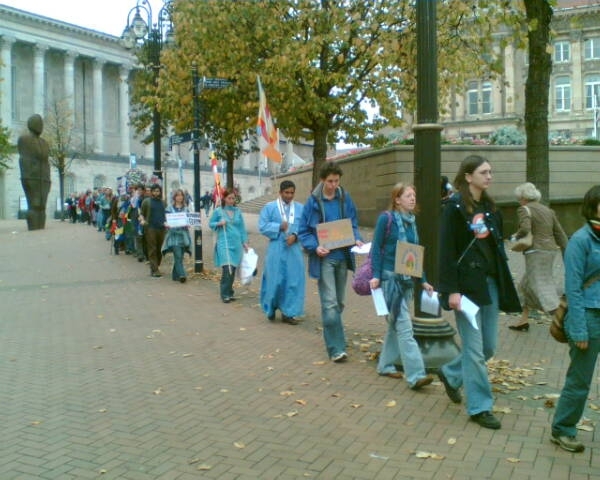
In Birmingham, around 70 people from the Birmingham Buddhist Centre – and others from Birmingham’s Inter-Faith Network - walked in a silent ‘yatra’ from the Town Hall along the main shopping street on a crowded Sunday. They gave out several hundred leaflets, explaining the situation in Burma and suggesting actions people could take in support of the Burmese people.

In Edinburgh, a group led by Kalyanavaca, the Centre’s Chairwoman, meditated in the City Centre, and gave out leaflets passing on Aung San Suu Kyi’s famous request to “use your liberty to promote ours”.

In Delhi, Maitriveer Nagarjun, an Indian Order Member, who is one of the core team for TBMSG’s Dhammakranti Project, helped organised a large public meeting at the prestigious Jawaharlal Nehru University where he is a post-graduate student. This was attended by Burmese survivors of the last military crackdown in Burma, and a signature campaign was organised calling on the Indian Government (one of Burma’s chief supporters) to cease investment until democracy and human rights have been restored to Burma.

In Poona, India, the Jambudvipa Trust, an FWBO/TBMSG ‘outreach’ project is contributing to discussions with the aim of organising a visit to Burma by senior Buddhist peacemakers.

Finally, Dayaratna, in Cambridge UK, would like to hear from anyone wanting to continue to support Burma, specifically by putting pressure on China, via the 2008 Olympics, to change its ‘hands-off’ policy towards the regime in Burma. Contact him if you would like to be part of this.

As Cait, organiser of the Birmingham Yatra, said, “We cannot know the outcome of our actions, but we hope that we have helped to keep the issue alive in the minds of those who saw us.”

Labels: , , , ,

Tuesday, October 02, 2007

More FWBO yatras in support of Burma

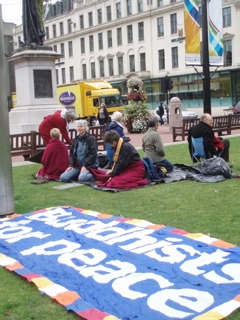
Since last Thursday’s post here, reporting the Cambridge Yatra in support of Burma, a number of other FWBO Centres and individuals have organised their own actions. In Brighton between 300 and 1,000 people joined a Dharma Yatra, walking silently between the Palace Pier and the Hove Peace Statue; Interestingly, the organisers estimated 300 and the local paper 1,000! In Glasgow the ‘Shambolic Warriors’ met to ‘Sit in Peace’ in George Square (see photo); and in San Francisco a women mitra organised her own ‘very quiet gesture of non-violence’ through San Francisco's financial district on Friday afternoon.

One of them, Ann, commented afterwards -

I felt deeply peaceful and connected in an unusual way with the suit-and-tie commuters, the dates on their way to supper, the bike messengers gathering for the Critical Mass ride, the prostitutes leading their johns into the public toilet, the German tourists riding the cable cars. We walked for two hours. People noticed. It felt good. Did it make a difference? Who knows. But I had to do it. May all beings be released from their suffering”.

There are plans for two more Brighton Yatras and a Birmingham Yatra through the city centre on October 14th and there will be an FWBO presence on the London march on October 7th.

Labels: ,

Thursday, September 27, 2007

Burma...

Many around the FWBO have been following the unfolding events in Burma with great concern, and have wanted to demonstrate their concern by taking some sort of tangible action.

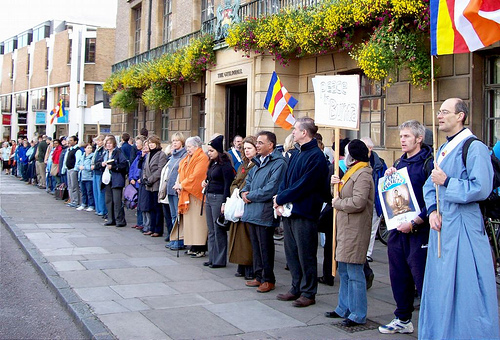
The Cambridge Buddhist Centre today organised a Yatra (meaning simply ‘walk’), followed by meditation, from the Buddhist Centre though the centre of town to the Guildhall. Some 70-100 people joined and the organisers expressed themselves as “delighted”. See a video clip on our Videosangha website.

Yatras have been used by Buddhists to help bring peace to several of the world’s most tense places, including Cambodia and Palestine.

Another Yatra is planned in Brighton for Sunday, and others are being organised in Birmingham and possibly London. Contact FWBO News for more information.

On Radio 4 Vishvapani presented today’s ‘Thought for the Day' on the Today programme, he spoke of how he’d returned from a retreat studying loving-kindness only to see words from the same ancient text emblazoned on the monks’ banners – and realised how loving-kindness leads naturally to action, even as a mother protects with her life her child, her only child… You can listen to his broadcast here.

Meanwhile a number of petitions have been circulating around the FWBO Sangha, one addressed to Burmese embassies around the world and one to the UK prime minister

In the words of the Buddha, please “do what you think it is the time for”.

Whatever living beings there may be;
whether they are weak or strong, omitting none,
the great or the mighty, medium, short or small,
the seen and the unseen,
those living near and far away,
those born and to-be-born,
may all beings be at ease.

Labels: , ,

Thursday, July 12, 2007

Jambudvipa team visits America

Jambudvipa is an FWBO/TBMSG project based in Pune, India, which - among other things - aims to internationalise the plight of India's vast ex-untouchable 'Dalit' community, from which come most of India's new Buddhists. Besides this they play a crucial role in disaster relief work with this community (see for example the report on their work after the Tsunami) - at such times India's age-old caste system rears its head with full force.

Mangesh Dahiwale, Jambudvipa's publicity officer, recently sent us this report on their recent - and ground-breaking - trip to the USA:

"As a part of Jambudvipa's vision to reach out to the world community and transcend barriers, and to generate international support for peaceful social revolution that Dr. Ambedkar launched, a visit to US was planned.

"Maitreyanath and Mangesh Dahiwale visited US during April 19-May 28, 2007. In the span of over 35 days, they moved from one city to another to give talks on evils of caste system in India, Dr. Ambedkar, revival of Buddhism in India and work of TBMSG. This visit was aimed at dissemination of information, raise support for the revival of Buddhism in India and develop alliances.

"During this visit, people from all different background co-operated, which included followers of Dr. Ambedkar living in US, social activists, academicians, black activists and Order Members of FWBO/TBMSG."

In the short time they were there they managed to meet a remarkable range of individuals and groups - from Tricycle Buddhist magazine and the Buddhist Peace Fellowship to the US State Department and five different universities and colleges, plus of course several FWBO centres, criss-crossing the country beween San Francisco, Los Angeles, New York, Cincinnati, San Diego, Washington, Indianapolis and elsewhere.

There are encouraging signs that caste prejudice and discrimination is increasingly being seen internationally not simply as an Indian social issue but a gross violation of human rights - see, for instance, recent references to this both in the UK's House of Commons and House of Lords where the UK Government minister is quoted as saying "My Lords, I agree with the noble Lord and with the Prime Minister of India —[Untouchability] is indeed a blot on humanity. Discrimination on the basis of caste identity constrains the human rights, livelihoods and life chances of millions of men, women and children. It is a systematic injustice and a routine violation of the most basic human rights..."

We are proud that the FWBO and TBMSG is able to play a part in making this more widely known and indeed in eradicating it.

Labels: , , , , ,

Friday, July 06, 2007

Shambolic Warriors return to Faslane

Sophia Young has sent us this report on Glasgow Buddhist Centre's network of engaged buddhists - the Shambolic Warriors.

We celebrated the summer solstice in fine style by taking a six mile hike to the North gate of Faslane naval base and peacefully meditating, dancing and singing outside. On Sunday 24th June - the 20 warriors, two children and a dog gathered on Helensburgh pier and,fortified by homemade scones and flapjacks, began the long trek to the base in heavy rain.

A detour for a cup of tea at the peace camp was made. Under a parachute canopy the shambolics shouted three saddhu's saluting the work of the peace campers who have been maintaining a presence at the base now for twenty-five years. Faslane naval Base situated on the River Clyde is the base for UK's Trident Nuclear weapons System.
The Campaign "Faslane 365" is drawing attention to the opposition that exists in the UK to Trident and any plans to update it. Diverse groups from around the country, including the Shambolic Warriors and the Network of Engaged Buddhists have been taking responsibility for organising individual days of the year long protest.
While there have been complaints about the heavy policing of such events- there are often as many officers as there are protesters, the day passed peacefully and happily, with much banter on both sides. Indeed, our lone protestor on the second day, Shantiketu,was offered lunch and given a lift back into Helensburgh by the duty cops.

The Shambolic Warrior Network was formed two years ago after Parami's Healing Self, Healing World retreat in Dhanakosa and members of the network lead actions in areas of concern to us. We are inspired and sustained by the ideas of Joanna Macy and the Work that Reconnects. Other strands of activity in the network currently include a housing project, environmental events in the centre, personal development workshops and womens group in the centre, outreach teaching of the dharma, cooking for large numbers ( we have the best catered events!).

Labels: ,

Wednesday, June 13, 2007

Intrepid women #2 - AIDS work in Uganda

Loren Treisman is a mitra from the Cambridge and Buddhafield centres. She’s been in Africa for the past eight months working first on AIDS-related projects in Uganda with an NBO called Tasaaga, latterly in Malawi in an orphanage. This is a report from her. She says -

“So I thought I would start with a brief low down on the general situation out here and then go on to the specifics.

AIDS is affecting EVERYONE. It's not as simple as treating patients. Every family I have met has either lost a member or is caring for orphans which few can afford, communities are losing health workers, teachers, basically all skilled workers to this devastating disease. It's an endless cycle where poverty increases the risks of becoming infected with HIV and being infected leads to greater poverty. I've been reading so much literature out here and I could tell you so much more, it's verging on impossible to describe quite what it is like out here where few people have access to basic needs such as clean drinking water, education and health care and where ignorance is killing people.

At the start of this year, I was working on Jana island, which is 1 of the Ssese islands on Uganda’s Lake Victoria (which is so large it looks like an ocean). The only access to the island is on a rickety boat which only goes once every 2 days (and that's in theory, in practice it goes less often). There's no electricity, no water other than the lake (or bottles which noone but me can afford), no permanent structures (mud huts only), no secondary school, no nurses or Drs, I could go on but I am sure you get the picture. There are approximately 1500 people on the island, excluding children and the HIV infection rate is estimated to be around 29%, though it is impossible to know as few people have managed to get tested. Women have a really hard time and since I have been here in Uganda (about 2 months) I have only managed to make one female friend but many males.

Following interviewing, I realised that the most vital necessities on the island were education and income generation. I devised an education program and gave daily seminars ranging from lectures to informal gatherings in the various villages on topics including nutrition, family planning, child abuse and labour. The receptivity was incredible and I was astonished at how much people listened. I have had villagers flocking to me for free condoms and femidoms which oddly enough they really like out here, telling me how much energy they’ve got having drunk more water, telling each other off if they saw child violence, it brings tears to my eyes to see the difference.

4 people died on the island while fishing (the only way to make a living in Jana), all in their 20's, which really got to me due to being unable to swim so I arranged swimming lessons in the lake. It was fairly tough teaching adults but some of them were getting there and I have encouraged them to train others.

My main work on the island involved setting up income generating schemes. I don't believe in hand outs, and people expect them here from people in the west so I thought the best solution was to start some project which helped the villagers help themselves. After many meetings, establishing viability of different projects, the fertility of soil, the skills available, etc, 2 projects were decided on-pineapple growing and pig rearing. By the time I left, with the help of many inspiring villagers land was cleared for 300 pineapples and there are 400 more to go and the pig house had started to be built and piglets secured from the mainland. A committee was established comprised of trustworthy community members who will decided how to distribute the money, based on those who work hardest and those who are unable to work due to old age or bad health The aim is for the profits to largely contribute towards supporting orphans, school fees and health care as well as to expand the projects to generate more income. People are so incredibly grateful.

Since then it's been Malawi and the city of Blantyre where I've worked in a very cool orphanage, the contagious smiles of African kids never cease to make my heart go gooey inside, I can't wait to teach some of them in August! My meditation has gone to new levels which is most exciting too. So much inspiration out here! Miss you all more than you know, it gets painful sometimes but I can't help following my dreams, Africa rocks my world!

SADHU Loren...!

Labels: , ,

Thursday, June 07, 2007

Dalai Lama invites TBMSG, workshop held introducing Tibetan community to needs of new Buddhists in India

Following on from our report on TBMSG's Delhi seminar, Lokamitra sends us this account of a potentially very significant meeting with senior Tibetan Buddhists in Dharamsala, North India.

This year is the 50th anniversary of Dr. Ambedkar’s conversion to Buddhism. In recent years the momentum of conversions to Buddhism from the Scheduled Caste communities (as well as other communities) has been increasing, and this year is doing so even faster. Millions of people throughout India have become Buddhist but very few have access to effective teaching. If they do not get guidance in Buddhism they will either develop very strange forms of Buddhism or they will return to Hinduism and their place at the bottom of the Hindu social order. Whatever the case, the conversion to Buddhism will have resulted in no individual or social change. TBMSG has been working in this situation for 29 years. We are doing what we can through training and through lecture tours and retreats throughout India, but the more we do the more we realise immensity of the task. We cannot do it all ourselves. We have to encourage other Buddhists to help. We can offer them our experience.

In 2005 the Dalai Lama visited Nagaloka and expressed his desire to help with our work. Encouraged by this Subhuti and I visited Dharamsala in October 2006 along with a good friend, Naresh Mathur, who is a member of the Dalai Lama’s trust. We had extremely satisfactory meetings with Ven Lhakdor (head of the Library and Archives), Samdhong Rimpoche (the Kalon Tripa or Prime Minister of the Tibetan government in exile) and Tenzin Geche (the Dalai Lama’s secretary), all of whom encouraged us to run workshops for Tibetan monks to educate them about Dr. Ambedkar and his Buddhist followers in India.

From 19th until 21st May in Dharamsala we did exactly that. We were assisted by Suvajra, Vivekaratna, Ojogeeta, Yashosagar and Kumarajiv. There were about 35 monks, nuns and lay people, mainly if not all from the Gelugpa tradition, some extremely well studied. In his introduction Samdhong Rimpoche emphasised that the Dalai Lama had himself asked that this workshop to take place.

The workshop consisted of a combination of presentations, question and answer sessions and group work. All went very well, but the group work seemed particularly effective. Thinking that most participants would be monks we only took one Dharmacharini with us. This was a great mistake. Almost half the participants were nuns, and Ojogeeta was much in demand.

The workshop gave the participants a broad understanding of the social and cultural situation (particularly caste and untouchability), Dr Ambedkar's life and achievement, and his understanding of Buddhism, and especially its social significance. It helped them understand the Dharmic needs of the new Buddhists, and the possible difficulties, notable among which was the question of karma. There was a great deal of interest in the FWBO/TBMSG. I am sure that the workshop will bear fruit in several ways, most importantly in bringing about more interest in and support for the Buddhist followers of Dr. Ambedkar in India.

Labels: , , , ,

Wednesday, May 23, 2007

Three remarkable women...

The last few months have seen three remarkable women from the FWBO taking their practice way off the cushion and out into the world. FWBO News hopes to do short reports on each over the next couple of weeks.

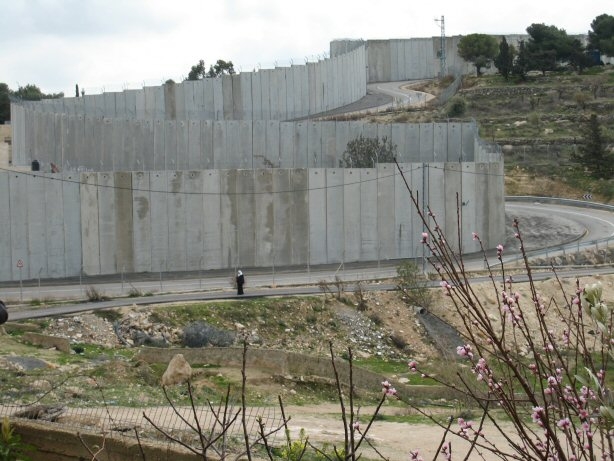
First is Zee-Zee Heine, a mitra (and long-time peace activist) from the North London Buddhist Centre. She was active in the North London centre's 'ESA'(Environmental and Social Action) group and before that in the FWBO's 'P.S... ecopractice network'. For the past two months she's been in Palestine working with EAPPI, the World Council of Churches' Ecumenical Accompaniment Programme in Palestine and Israel. Her work has been a varied mixture of personal training, checkpoint watches, accompanying children to school past violent Israeli settlers, interviewing victims of military or settler violence, and sending news of what is happening to friends and contacts in the West.

Here is an excerpt from her latest report -

"...we went to a two-day conference on Popular Resistance in a village called Bil'in. On the third day was to be a peaceful demo, however it is a village which has a demonstrations every week about the fact that the wall goes through the land of the village and denies them access. The organisers said the demo was always peaceful but sometimes youths of the village when they saw Israeli soldiers on their families land would feel they had a right to throw stones at them, and the soldiers would respond violently.

Part of the conference included what in Britain is called pre action training. For example we were told that if the youths were seen to be collecting stones one could go over and talk to them, if the soldiers started firing rubber bullets the safest thing to do is to sit down, allow things to calm down and then slowly get up and drift forward whereas if they fire tear gas it is better to disperse up-wind and then regroup. But because of the big conference there would be many extra people including many internationals, so the organisers thought it unlikely that the demo would become violent the next day.

In the event we gathered in the centre of the village and walked down the road towards the separation barrier. Just as we reached the outskirts of the village, when we were still about half a mile from the barrier and still all on the public highway, the Israeli solders started firing tear gas without any provocation. I was amazed. Some of the other EAPPI volunteers and I went back to the house where we had gathered and watched from the roof. Two others ran over the pastures and got up wind of the tear gas and stayed much closer and took lots of photos. The solders followed the tear gas with plastic coated metal bullets and water cannon. Very different from any British demo I have been on."

She will be back in early July and concludes her report by saying "When I return I want to do speaking engagements to let people know about the conditions in Palestine." If you can help arrange any in the UK (or beyond!) please let her know directly on zeezeeh [at] googlemail.com


Next in this series - Loren Treisman from Cambridge/Buddhafield. Suggestions for other entries welcome...

Labels: ,

Monday, March 05, 2007

FWBO Karuna

Karuna Trust need two wome