Tuesday, April 22, 2008

Dalit art in Delhi

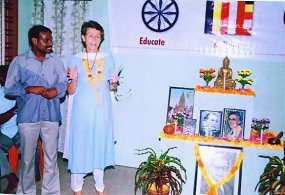
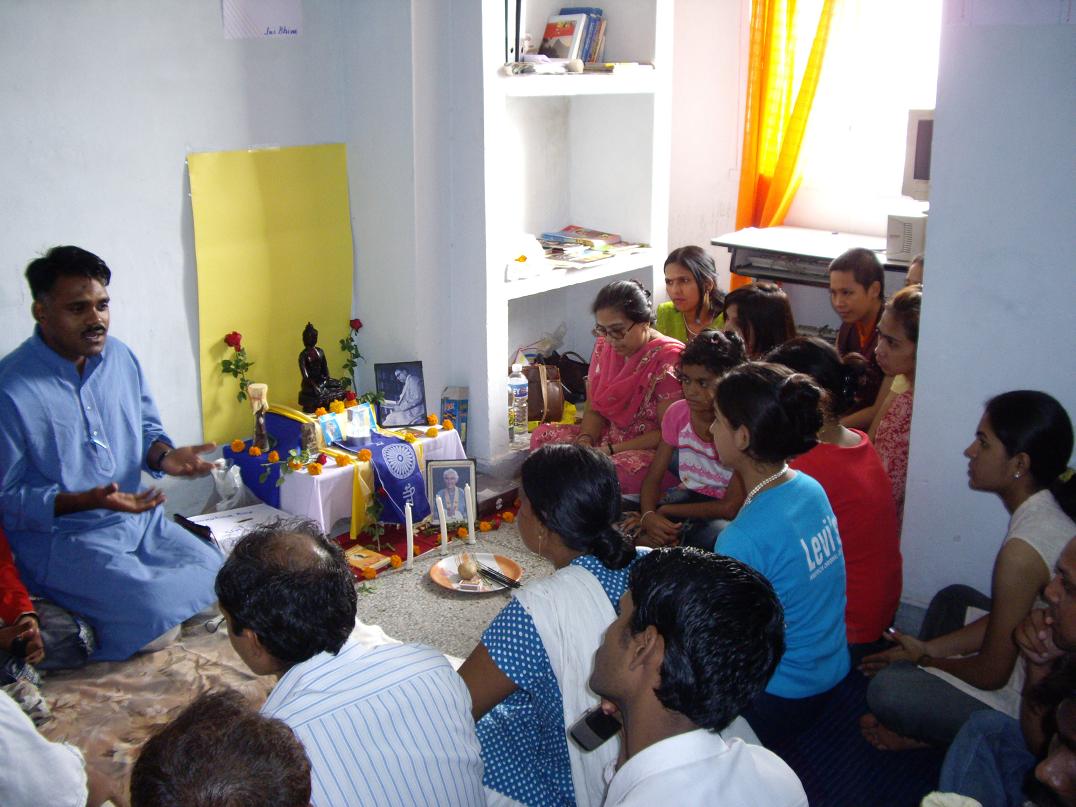
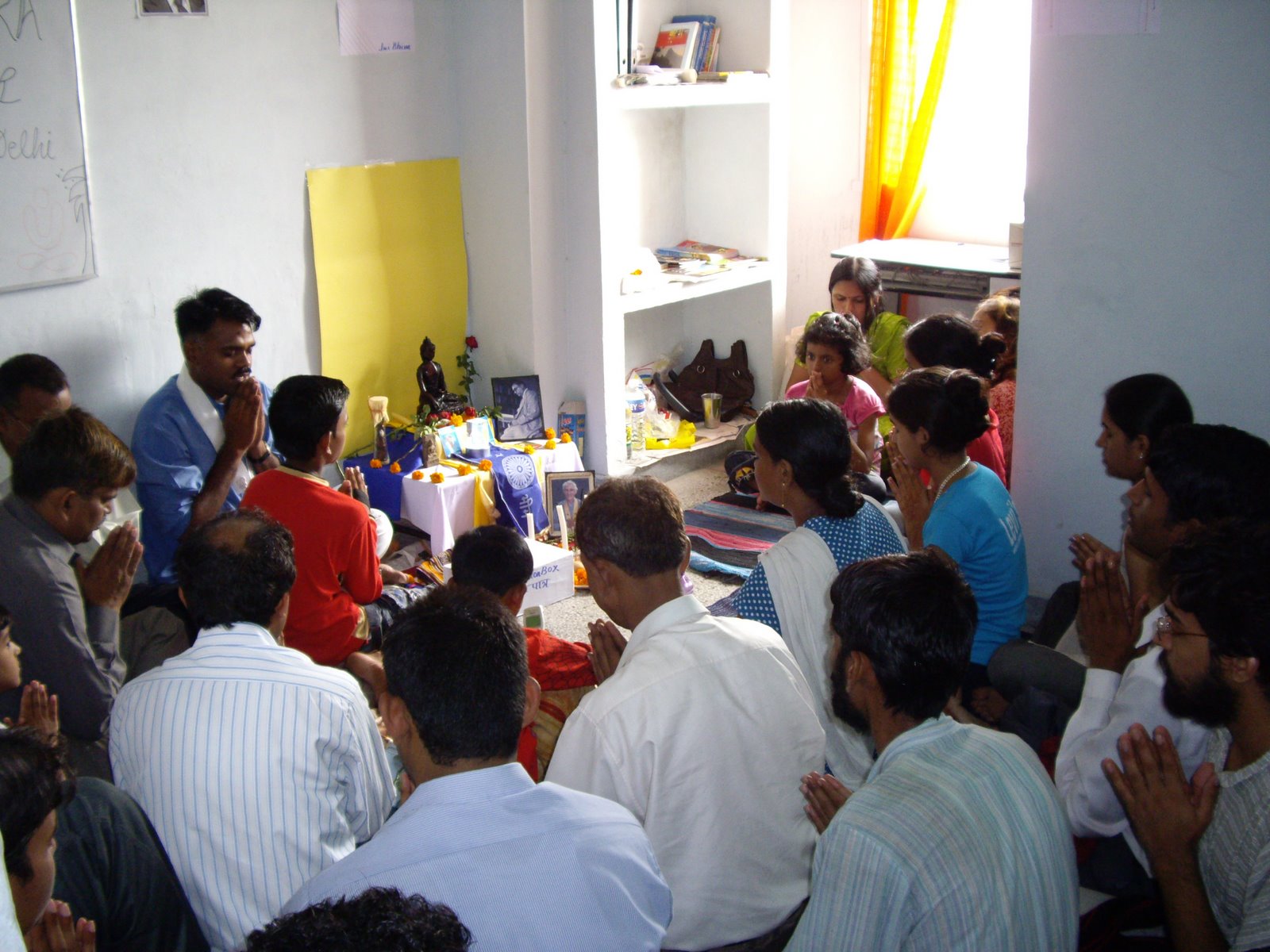
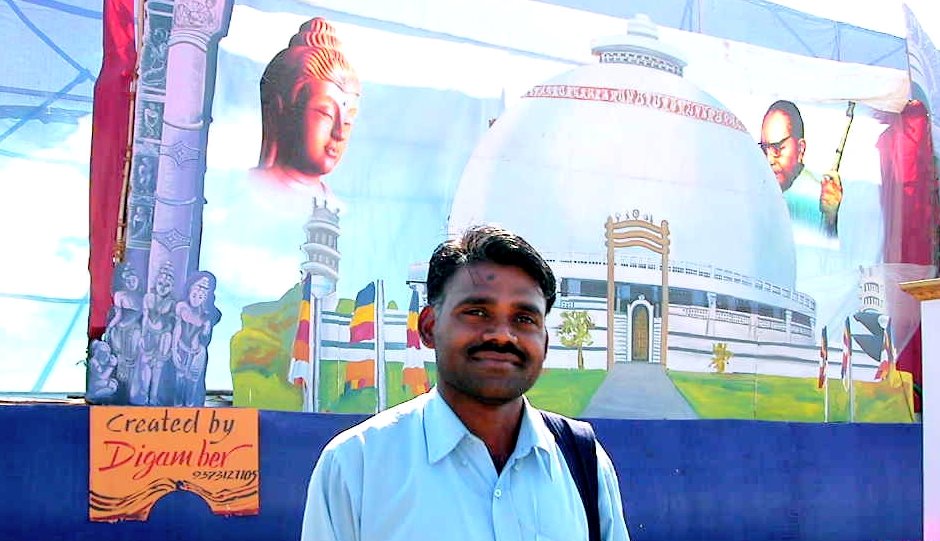
Maitriveer Nagarjun (shown left) is an Indian Order Member, studying at the prestigious JNU university in Delhi. Besides leading Dhamma classes at the university and travelling all over northern India to visit Buddhist local groups, he’s recently been helping organise ‘Eyes Re-Cast’ – possibly the first ever exhibition of contemporary art based on the philosophy of Dr. Ambedkar and the Buddha.

The painter, Savi Sawarkar, is India’s most eminent Dalit painter and print-maker. His art is angry, outspoken, and direct - causing Gary Tartakov, a professor at JNU, to comment "He doesn't sell real well [in India]. He sells internationally".

As if to bear this out, a simple Google search reveals an exhibition review from the Iowa State Daily in far-away America. They quote Eleanor Zelliott, a sympathetic academic who has for many years specialised in Dalit studies, and author of ‘Untouchable Saints: An Indian Phenomenon’. She comments "His art work targets Brahman orthodoxy. One painting which I find very touching is one of an untouchable carrying a dead cow across his shoulders, a comment on the traditional duty of the untouchable to carry carcasses from the village."

One painting that demonstrates Sawarkar's willingness to provoke is his interpretation of Manu, the great law-giver of India. Sawarkar portrays him as a monster because it was Manu who gave the laws that included the caste system that made Savarkar a Dalit. These laws made crimes against an untouchable insignificant, but crimes against Brahmans, the highest class, to be the worst thing a person could do. The Brahman view of Manu, by contrast, portrays him as prestigious and god-like.

You can see a small slideshow of Sawarkar’s paintings on FWBO Photos here – or see below. And if you happen to be in Delhi, go visit the Lalit Kala Academy Gallery, where the exhibition runs up to 30th April.

Labels: , ,

Saturday, February 09, 2008

Dispatch from Delhi

Saul is a mitra from the FWBO’s North London Buddhist Centre. Last month he travelled to India to team up with the Amida Trust, who have for some three years now been running English classes in Delhi under their ‘Buddhist voluntary service overseas scheme’. He sent FWBO News this report -

“I’ve recently finished two weeks teaching very large classes of children from slum areas in Shahadhara in east Delhi. At first I couldn’t cope with it, or I felt I couldn’t cope with it. Then I became rather accustomed to it and I've missed it on leaving.

Classes were hectic affairs with anything from 45 to 70 children there. Shabbily dressed with big open smiles and irrepressible enthusiasm. I say hectic because children were coming and going from the classroom during the class. When I commented on this I was told that it was better than before!

These classes were usually conducted in half built Buddhist viharas in the slum districts. The conditions were extremely basic. Blackboards, when there were any, were crude and basic. Power cuts would frequently plunge the vihara into darkness. Equipment minimal. Paper rare and books next to non-existent.

We travelled to these outreach classes on rickshaws or in auto-rickshaws “tuk-tuks’ through the chaotic Delhi traffic. All manner of traffic: bicycles, motor bikes, ox carts all vied with lorries, buses and cars. The rules were pretty minimal, nobody worried too much about traffic lights or the right of way, not everyone even drove on the same side of the road. I confess I found it all rather exciting.

Outside the vihara there was the seething mass of humanity: beggars and street vendors, endless stalls and tiny stores; incessant activity and the omni-present smell of sewerage. Sometimes our classes were conducted in order to increase the harmony in conflict torn communities. Occasionally they were in relatively harmonious Buddhist communities. Their poverty was what they all had in common.

After two weeks’ I was used to it! The classes were led by two spirited individuals – Shiasnu (Joy) and James Goodman – who against all odds managed to maintain their teaching. We were working for ADEPT – the Amida Delhi Education Project Team. At first I can’t say I really I really warmed to their approach, which involved lots of song and movement. Then I realized that actually it did really work because it motivated and enthused the young learners. Mostly I’ve been used to teaching adults so it was a bit of a culture shock. The sessions with the children didn’t seem like ‘real lessons’ but then I'd been thrown into a situation where they didn’t necessarily have blackboards, only occasionally notebooks, and so on. Use of movement motivated them and they clearly enjoyed the classes. Whenever someone did well Joy would call out ‘give that child a sticker’ and they would proudly walk out to the front of the class to get their sticker. The teachers refused to allow any smacking to discipline the children and they tended to get overexcited and classroom control seemed problematic. Then I started to realize that they were actually succeeding in increasing the confidence and self-esteem of these children.

At first I found it all rather exhausting and overwhelmed by these classes. Delhi in midwinter was a hard way to start in India, not even the food would stay in my stomach! Everything, just everything had changed. But I got used to my little room on the roof of the block, even when the cold North West winds blowing off the Himalayas tried to invade it. My tolerance of noise shot up, and later, as I started taking tea at roadside cafes with the workers, neighbours started to recognize me, little routines started to take over – and then, so quickly, my stay there was over and it was time to take the train south to Nagpur and more English teaching with the TBMSG’s many projects there…

Labels: , , ,

Thursday, November 15, 2007

Ongoing actions in support of Burma…

Events across the FWBO continue to be held to draw attention to the situation in Burma and build support for peaceful change there.

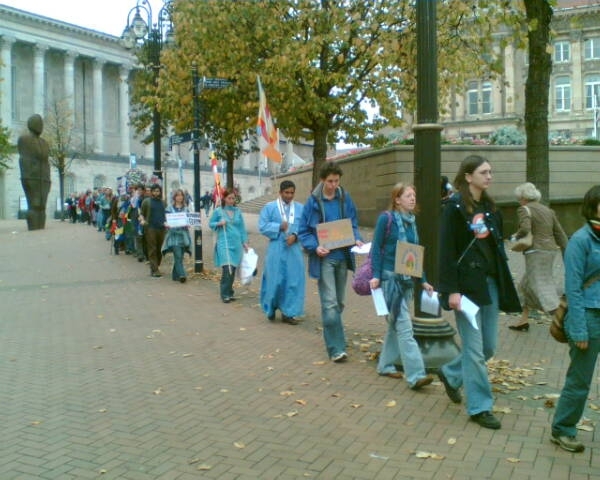
In Birmingham, around 70 people from the Birmingham Buddhist Centre – and others from Birmingham’s Inter-Faith Network - walked in a silent ‘yatra’ from the Town Hall along the main shopping street on a crowded Sunday. They gave out several hundred leaflets, explaining the situation in Burma and suggesting actions people could take in support of the Burmese people.

In Edinburgh, a group led by Kalyanavaca, the Centre’s Chairwoman, meditated in the City Centre, and gave out leaflets passing on Aung San Suu Kyi’s famous request to “use your liberty to promote ours”.

In Delhi, Maitriveer Nagarjun, an Indian Order Member, who is one of the core team for TBMSG’s Dhammakranti Project, helped organised a large public meeting at the prestigious Jawaharlal Nehru University where he is a post-graduate student. This was attended by Burmese survivors of the last military crackdown in Burma, and a signature campaign was organised calling on the Indian Government (one of Burma’s chief supporters) to cease investment until democracy and human rights have been restored to Burma.

In Poona, India, the Jambudvipa Trust, an FWBO/TBMSG ‘outreach’ project is contributing to discussions with the aim of organising a visit to Burma by senior Buddhist peacemakers.

Finally, Dayaratna, in Cambridge UK, would like to hear from anyone wanting to continue to support Burma, specifically by putting pressure on China, via the 2008 Olympics, to change its ‘hands-off’ policy towards the regime in Burma. Contact him if you would like to be part of this.

As Cait, organiser of the Birmingham Yatra, said, “We cannot know the outcome of our actions, but we hope that we have helped to keep the issue alive in the minds of those who saw us.”

Labels: , , , ,

Thursday, May 31, 2007

New map of FWBO/TBMSG in India

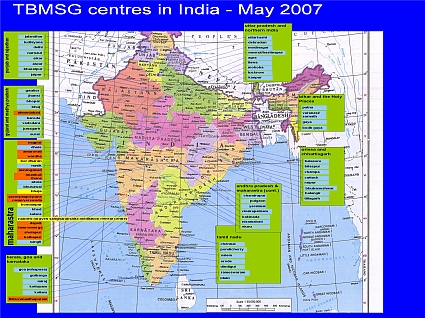
A new map is available on-line of all FWBO/TBMSG groups in India. Click here to see it and/or download it from the FWBO Photos site on flickr.

This is probably the first time all of our many centres and groups in India have been collected and made visible in this way. Comments and corrections welcome. For contact details for the centres go to the TBMSG website; for contact details for the smaller groups the best is to try Nagaloka, Dhammakranti outreach project, or the Jambudvipa in Pune

There are also maps on the flickr site for the FWBO's centres and groups in Europe, the UK, and around the world.

You might also like to try exploring Google maps and searching for 'FWBO' or 'TBMSG' - in many cases, incuding in Inda, it is possible to zoom in to a street-level view of our actual centres. Check the Mahavihara in Pune for intance.

Labels: , , , , ,

Thursday, May 17, 2007

Dhammakranti team begin 2007 season

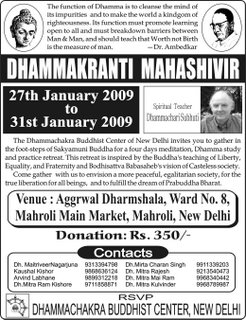
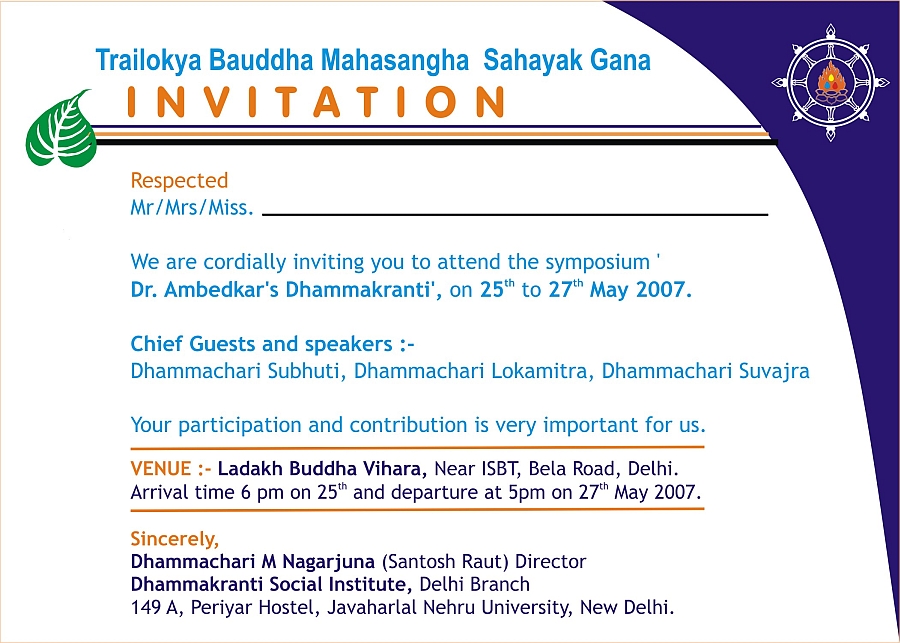
In India, the Dhammakranti team are starting their 2007 season with an ambitious event in Delhi.. Subhuti, Suvajra, and Lokamitra will all be participating in a seminar aiming to spread awareness of Dr. Ambedkar and his vision for a casteless society.

This is part of a determined strategy to spread our activities beyond the geographical borders of Maharastra, heartland of Buddhism in India and home to 60 million people – but a fragment of the whole of India. It is also part of their effort to highlight the abuse of fundamental human rights implicit in the widespread caste discrimination still practiced in India. See http://atrocitynews.wordpress.com/ for some of their work.

In this respect we are delighted to note the recent comments made in the UK’s House of Commons and House of Lords – both have recently seen debates in which members have strongly condemned the practice of casteism and the plight of the Dalits.

The event will be held on 25,26,27, May, 2007 at the Ladakh Buddhist Monastery - near ISBT, Bela Road , New Delhi, India. All are welcome and entry is by donation.

Labels: , , ,