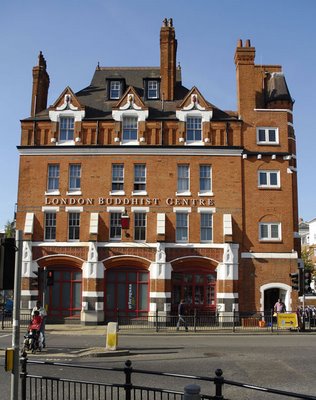
Maitrivajri writes with news of a cycle of celebration at the FWBO’s London Buddhist Centre: an honouring of the little-known Five Prajnas, the ‘female’ counterparts of the Five Buddhas in the well-known Five-Buddha Mandala.
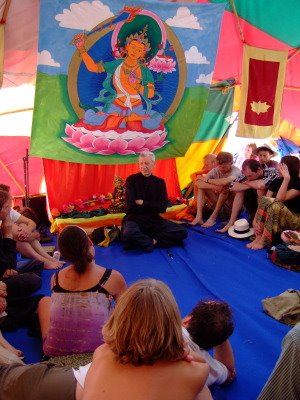
She says - “This year we are ritually celebrating the female Buddhas, or Prajnas, on the day and time of the year associated with each of them. We began the cycle with the Summer Solstice and female Buddha Mamaki. We are performing outdoor rituals.
“The rituals are open to those who know both our meditation practices and have some experience of Buddhist ritual. It would be great if the Prajnas received more attention! The Mandala of the Five Prajnas is a symbol and image for the wisdom of the Buddhas.”
Next up, on September 20th, the Autumn Equinox, is a ceremony dedicated to Pandaravasini, the female Buddha of the Western direction associated with dusk and the wisdom of uniqueness.
Later in the year it is the turn of Samayatara, the female Buddha of the Northern direction associated with midnight and the wisdom of action (to be held over the weekend of Halloween/Samhain); and Akasadhatesvari, the female Buddha at the centre of the Mandala beyond time and space. She is associated with the ineffable wisdom of the Transcendental. Her ceremony will take place at the time of the Winter Solstice, Sunday Dec 21st.
To mark the occasion they’ve arranged a ‘30th Anniversary Urban Retreat’ running from 9th –16th November; it started Sunday with a period of ‘setting intentions’ for the week ahead. They then moved into more ceremonial mode with a Grand Unveiling, by Sangharakshita, of a new 12-foot triptych, painted by Aloka, for their new basement shrine room.
This will form part of the LBC’s new ‘Breathing Space’ area - Breathing Space is the London Buddhist Centre’s growing programme for health and wellbeing; it teaches meditation and mindfulness techniques that can help people who have struggled with depression, addiction, stress and anxiety to look after their own mental health. It’s also a resource center for carers in the area, helping local carers learn how to reduce the stress that can come with intensive caring responsibilities. They’ve produced a video, ‘Caring for the Carers’ and been featured in the UK’s ‘Guardian’ newspaper.
On the Urban Retreat itself - in which 146 people are participating - they say “you decide what commitments to take up while going about your usual routine. We will support your efforts by opening the Centre for morning meditation, hosting special classes, and sending you daily text messages and audio downloads. We start with a day retreat in which the new shrine room painting will be unveiled, and we finish with a day retreat and then Sangha day.
“In the evenings there will be free classes all week, including newcomers’ meditation classes from 7.15 to 8.15pm, followed at 8.30pm by a series of very special events celebrating the people and positivity of the LBC.
“We want everyone who comes to the LBC to attend this year’s 30th anniversary Urban Retreat – so the week is free of charge for all".
More details of the retreat - and Breathing Space - are available on the LBC's website.
Breaking News - next June FWBO centres across the world will running an International Urban Retreat to which all members of the whole FWBO Sangha are invited. The dates are June 20-27th; watch this space for more details…
There’s an introduction to the theory and practice of Urban Retreats- as developed by the FWBO’s Sheffield Buddhist Centre - on FWBO Resources here.
The FWBO’s Dublin Buddhist Centre have produced a special version of their Newsletter, celebrating their team’s recent victory on the football field. FWBO News has obtained a sneak preview and is happy to leak it here. They say -
“It was third time lucky for the boys in green who ran out winners in the FWBO’s annual football World Cup, organized by Jayaraja.
“The Irish Team comprised Osadha, Vajrashura, Ahimsaka, the cultured left foot of Frank Balfe, John Greaney and Javier (a late call-up who apparently qualified for the Republic after correctly locating Ireland on a map!) In the closest-fought competition of recent years, the Irish faced tough games against London and Cambridge before the final showdown with Brighton – at which point the winners would lift the trophy, a draw would hand victory to Buddhafield.
“With 30 seconds remaining and the game still scoreless, Osadha broke free with a man to beat and buried the ball in the bottom left-hand corner securing a win for Ireland”.
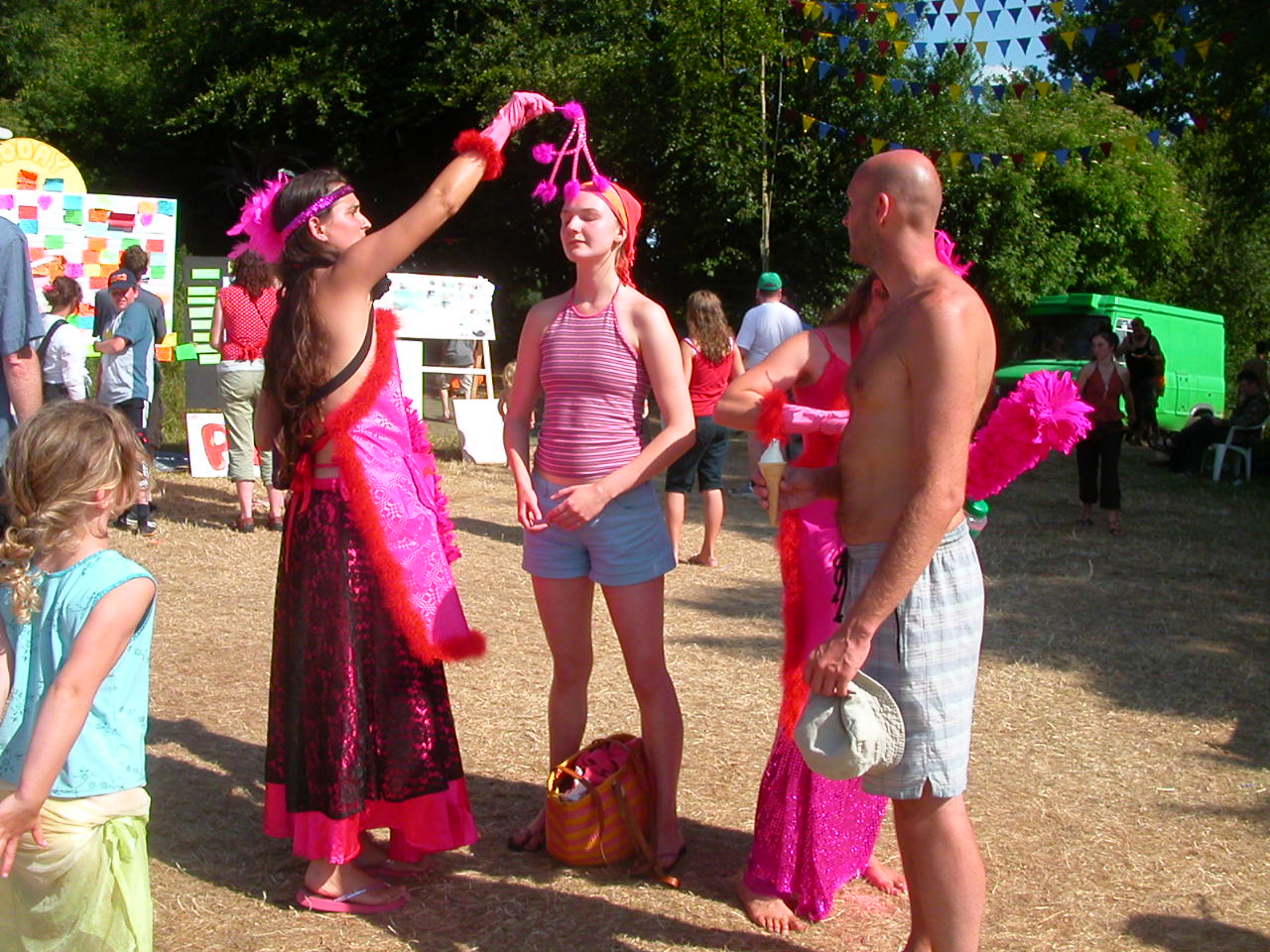
The FWBO’s largest event outside India is the annual Buddhafield Festival, now in its 13th year and going strong. From 350 in 1996 it’s grown to around 2,500 people – small enough to retain the intimacy that’s one of its hallmarks, yet large enough to contain an extraordinary diversity of, well, everything!!!
This year they’re moving to a beautiful new site just a few miles from the old one on the Devon-Somerset border. They’ve written to FWBO News to say –“The new site is secluded and peaceful, away from roads, with coppice woodland, and plenty of space. We’ve been hard at work preparing for this year’s Festival – and it’s coming up soon! We warmly invite you to join us – and please do tell your friends. It’s a great way for them to meet a bunch of Buddhists and get a taste of what we’re about”.
Here is a sneak preview of some of this year's programme (all included in the ticket price!!):
Kids Area: AMAZING and varied range of activities for kids - trampolines, dressing up, carnival processing, crafts, bushcraft and nature awareness, storytelling, toddlers' space, daily theatre extravaganza; Teens Space.
Bands: Gadjo Club (superb Gypsy Balkan Jazz); Seize the Day (protest folk stalwarts); Green Angels (upbeat Breton dance); Vogue Gyratory (Brighton faves, 7 piece funk-reggae); Manjinga 7; Toggy Mess (upbeat Irish folk); Manos Puestas (super-spicy flamenco jazz); a variety of fantastic DJs, including Matt Black of Coldcut (Thurs pm), followed by Cinema
Poetry and art: Inter-Ference; open mike poetry evening; Poetry Slam; 'The Big Q' play written specially for Buddhafield!; The Buddhafield 'Artery'; carnival costume-making from found natural materials; creativity and poetry-writing; Mr Be, mime, clown and family show; Stilted butterfly walkabout; Marionettas giant puppets.
.Dharma Parlour and meditation: talks and discussions on Buddhism, speakers from the Western Buddhist Order and other traditions, including Christopher Titmuss. Meditation teaching from FWBO teachers and others. Ceremonies and devotional practice. Network of Engaged Buddhists; Amida Trust, and others.
Workshops: MASSES of all-day yoga, Tai Chi and Chi Gung. Healing Area, great range of alternative therapies, pay by donation. Dozens of workshops to die for, including Ecstatic Dance with Jewls; 5 Rhythms with Jo Hardy; Brazilian Forro; Indian Classical Dance with yoga/visualisation; Shamanic Trance Dance with Zilia; many more dance workshops; 'Soulful Singing' with Mahasukha; 'Voice as Sacred Instrument'; Tibetan singing bowls; tin whistle, bodhran, drumming; daily Buddhafield Community Rhythm event; 'Work that Reconnects'; Transition Towns; big debate on Climate; Palestine Peace Campaign; Non-violent Communication; Skilful Flirting; Heart-to-Heart tantric workshops; Green babycare on a budget; Shamanic Journeying from Northern Drum….
Special Spaces: the 12 Step Dome; Women's Space; Land and Permaculture; Radical Midwives Space for pregnant women and new mothers; Queer Spirit Space; Crafts Area; Wildheart Medicine Wheel Space; Dzogchen and Big Mind teachings; bushcraft; tracking; fire making; sky-gazing meditation.
Saunas including Lost Horizon, featuring chillout space and cabaret; cafes including the Buddhafield Café with strolling musicians. And last but not least, wood-fired showers and compost toilets; all power on site from the sun and wind.
The 2008 Festival runs from Weds 16th to Sun 20th July. The site has good public transport links; nearest train and coach station is Taunton (direct trains from many towns); there are a couple of local buses each day from Taunton direct to the site. There's also special festival mini-buses going direct to the site and back from Bristol, Brighton and London. See the Buddhafield Festival website for details. Don't be put off by the rather severe website by the way - look at the pictures to get a sense of what it's really like!
But PS - don't forget to book soon! See you there! ;-)
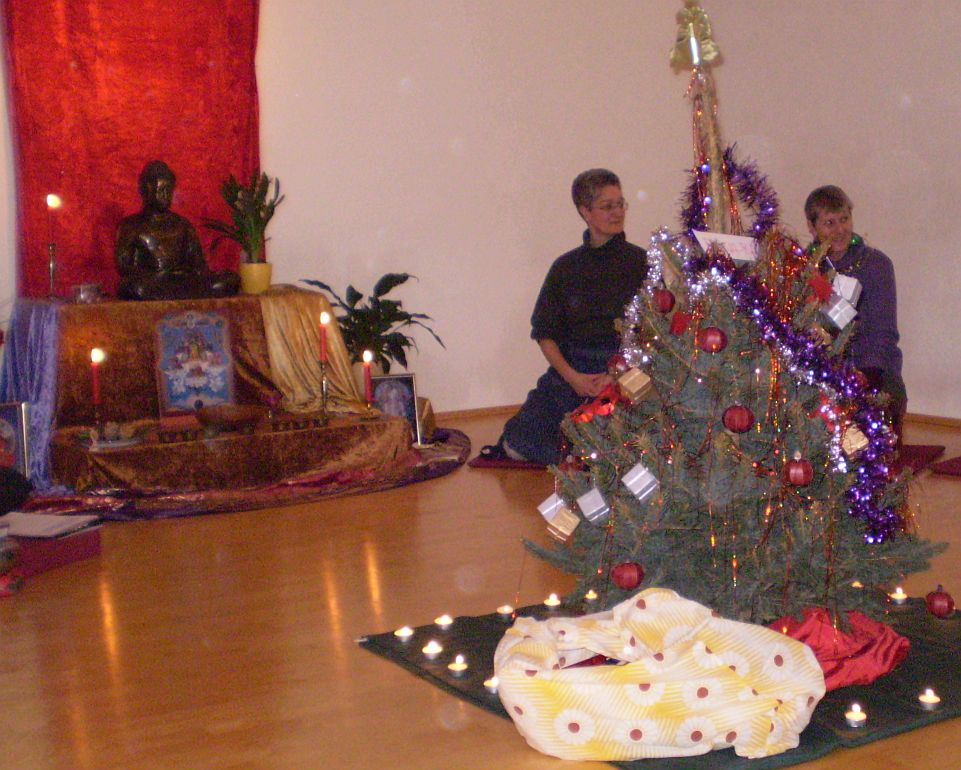
On 22nd December 20 people celebrated the winter solstice with a Dana-Day festival in 'Buddhistisches Tor', as the FWBO's centre in Berlin is known.
Amogharatna, the Centre's chairman, said "It was the first time, as far as I know, that we have had a decorated "Year's End tree" (as christmas trees were officially renamed in former East Germany) in the centre. The idea behind the celebration was to take some of the pre-Christian elements of Christmas, as well as positive ingredients of the Christian festival such as generosity, and set them in a Buddhist context. As well as meditation and puja the celebration included acknowledging our gratitude to others for what they have given us, a chance to express our hopes for the coming year and sharing presents around the tree. At the end we had a small feast of gingerbread and (non-alcoholic) punch. We hope the event will become a regular feature of our programme in the future."
This year at the Essen Buddhist Centre in Germany four teenagers celebrated their ritual of leaving childhood. About 80 people attended the ceremony, which was probably the first time ever such a rite of passage for teenagers was held at an fwbo centre.
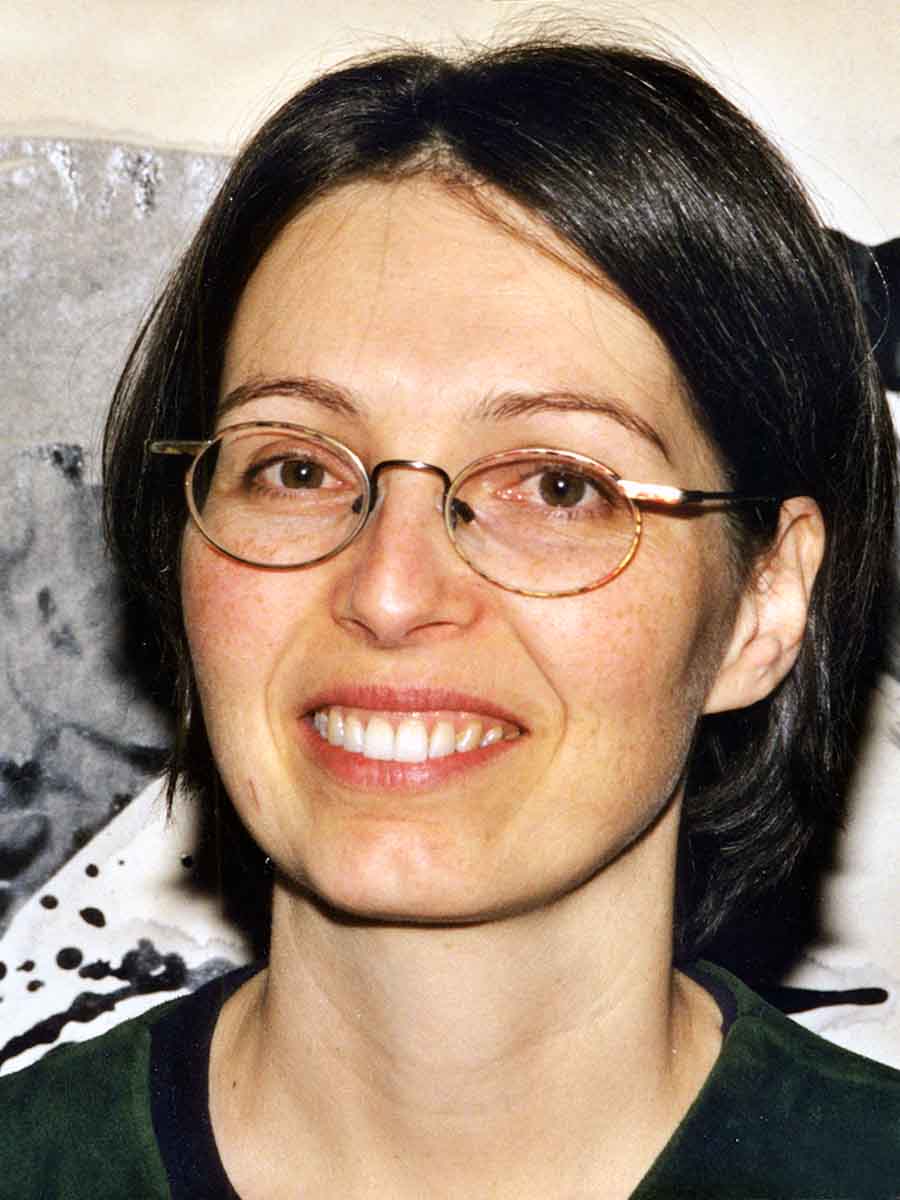
Jnanacandra (photo left) initiated and led the event and told FWBO News: “I believe that as a spiritual community it is important that we support each other at important junctions in life. There are several main transitions in a life-span, some of the more obvious ones being birth, coming of age and death. Traditional societies knew of their importance and usually had established means of celebrating them in order to help those transitions to happen as smoothly and skilfully as possible. Modern societies have often lost the awareness of their importance.
“In our Sangha we do have quite a number of families whose children have often attended families retreats and know each other. I felt it was important that at the age of 13/14 we offered them a way of acknowledging that something important was changing in them and in their relation to their parents. Something dramatic happens around that time in a person’s life and I felt that in making it more explicit we could support those involved, i.e. the teenagers themselves and their parents, by stressing and ritually invoking the positive forces involved in the process of change.”
“Of the seven teenagers aged 13 or 14 who were invited to take part four girls decided to have the ceremony. For three months before it they met weekly with Jnanacandra and explored issues around growing up: reflecting on their values in life, looking back at their childhood, exploring their relationship with their parents, as well as some outings like taking part in a first-aid-course and spending a morning at court.
“For the ceremony itself the girls were free to invite whoever they wanted, so we had grand-parents, wider family, peer friends and some friends from the Sangha. “We made it clear from the start that the ceremony was not strictly ‘buddhist’ i.e. they weren’t commiting themselves to buddhism in any way, although the ceremony certainly reflected buddhist values.” The ritual consisted of three parts which could be described as ‘connectedness’, ‘letting go’, and ‘evoking strength’.
The first part of the ceremony, ‘connectedness’, was dedicated to looking back. After a brief reflection on their childhood the teenagers and their parents gave expression to their sense of connectedness, mutual respect and gratitude by bowing to each other and by exchanging a symbolic present representing what they particularly valued in each other. This emphasized the deep bond between them that formed the stable basis from which the young people could go out to find their own way in life.
The second part of the ceremony, ‘letting go’, focussed on the process of letting go of the child by her parents that necessarily happens around that age. It was symbolically enacted by one of the parents cutting off a curl of their daughter’s hair. This was later to be thrown in streaming water. As they later confirmed, this had quite a strong emotional impact on some of the parents.
The third and final part of the ceremony, ‘evoking strength’ evoked the strength that the girls will need in order to venture into the turbulent years ahead of them. Holding a “power object” that they had previously chosen and ‘charged’, each of them listened to a beautiful Rejoicing in Merit by their elder sister, parent or grandparent. In this they were reminded of the many beautiful qualities that they have and that will help them through the bardo of adolescence that will take them to adulthood.
The ceremony was framed with live music by schoolmates of one of the girls and ended with the chanting of the blessings. After the formal part, there was coffee and cake and after that the families went off to continue their celebration at home. Many people voiced their appreciation of the event and expressed the hope that it may become a part of our culture across the FWBO.
A big marquee has been hired, the first publicity printed, the website is launched, the list of invited teachers is growing… preparations are well underway for the FWBO International Retreat...
Next year, FWBO Buddhist Centres from all over Europe are joining forces in a new venture. From 22nd to 26th May at Taraloka in the UK, in conjunction with Buddhafield, there is going to be a big retreat. The idea is to bring together people in large numbers to practice, learn about, and celebrate the Dharma of the FWBO. Many of our best and most experienced teachers will be there to teach meditation, give talks, or lead puja and ritual.
Vajragupta, who is one of the main organisers of the event, says: “Everyone from the FWBO is welcome, whether it is your first retreat, or you’ve been on retreat many times before. Come and experience the magic and inspiration of practising together in large numbers!”
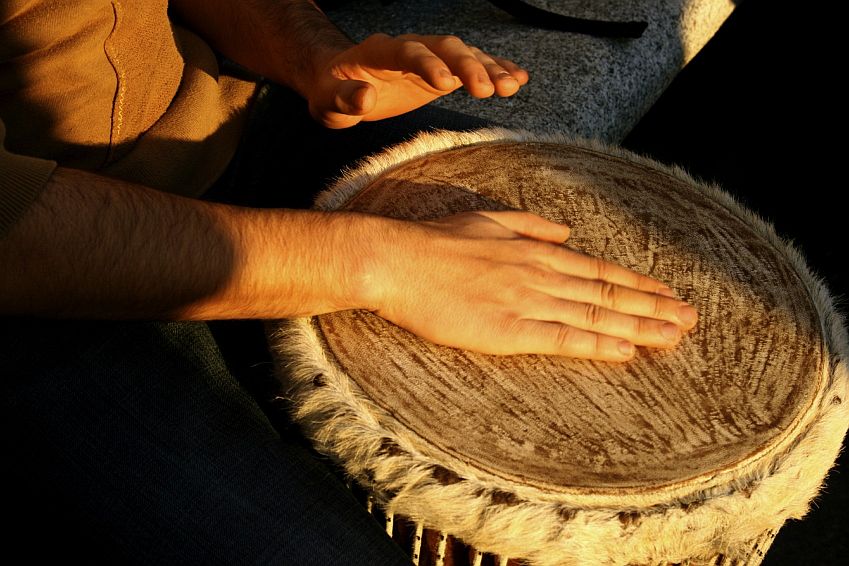
The weekend takes place just a few days after Wesak, the full moon day of May on which Buddhists all over the world celebrate the Buddha’s attainment of Enlightenment. So the theme will be “Beating the Drum of the Dharma” – exploring what the Buddha did next, how he took the Dharma out into the world, how he lived-out his newly discovered Wisdom and Compassion.
More details about the event will be available in the autumn. Look out for brochures at your Buddhist Centre and for the website www.internationalretreat.fwbo.org
For the last five years the FWBO Sanghas from Holland, Belgium, France, and Germany have come together to celebrate FWBO Day. We held great festivals in Ghent and Amsterdam, and this year we will meet in Essen to celebrate the 40th FWBO Day together.
This year the celebrations will be spread over the entire weekend (31 March/1 April), because there is more than one birthday to celebrate. On Saturday we will start with Bhante's Going Forth 60 years ago. Khemasiri from Holland will give a talk on Bhante based on her pilgrimage last year to places where Bhante lived in India.
On Sunday we will celebrate the 50th anniversary of A Survey of Buddhism, Bhante's major work. Dharmapriya will talk about Bhante's thought. In the afternoon Lalitaratna will give a talk on the first forty years of the FWBO.
Each talk will be followed by a puja: on Saturday a Buddha Puja and on Sunday pujas for the Dharma and Sangha . The talks and the pujas will be in English, with the Heart Sutra in French, German, and Dutch (Translations of the talks into French, German, and Dutch will be provided.)
The Friends of the Western Buddhist Order (FWBO) was founded in 1967 by Sangharakshita. It is now an international movement with activities in more than 20 countries, including India, where it is known as the TBMSG, the 'Trailokya Bauddha Mahasangha Sahayaka Gana'. The FWBO/TBMSG is a non-sectarian Buddhist movement which seeks promote the practice of Buddhism in a form appropriate to the modern world.

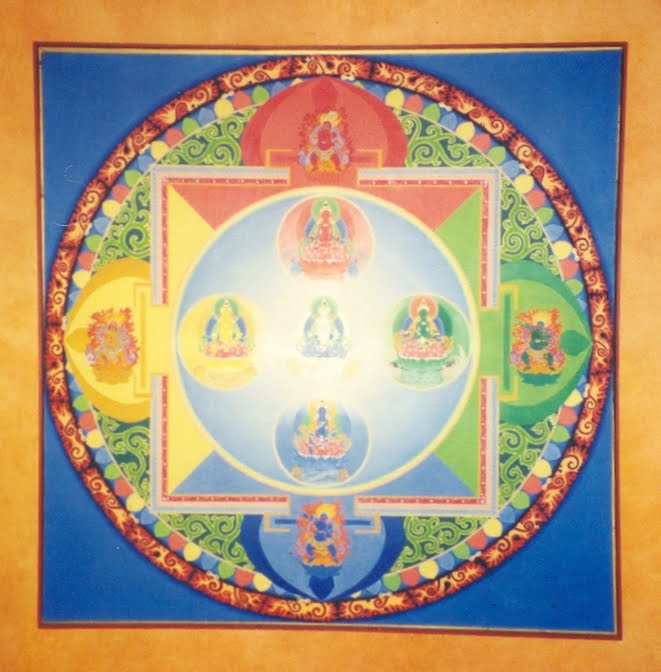 Maitrivajri writes with news of a cycle of celebration at the FWBO’s London Buddhist Centre: an honouring of the little-known Five Prajnas, the ‘female’ counterparts of the Five Buddhas in the well-known Five-Buddha Mandala.
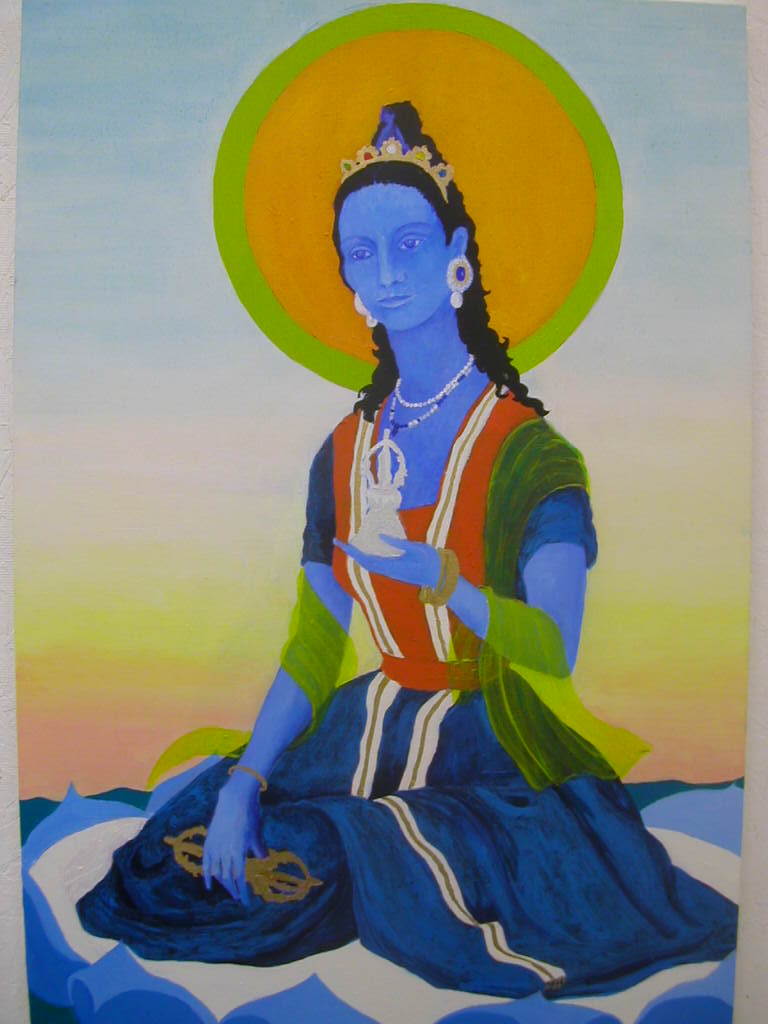 Next up, on September 20th, the Autumn Equinox, is a ceremony dedicated to Pandaravasini, the female Buddha of the Western direction associated with dusk and the wisdom of uniqueness.




 rss
rss