Jyotivana Women's Community in Manchester Unveils Beautiful New Shrine Cabin
Dayanandi writes from Manchester with news of the women community's new shrine cabin. She says -
 “15 months ago it was the dream of the Jyotivana women's community here in Manchester to have a shrineroom where the community could meditate together. Our previous meditation space was an unheated attic accessible only via a loft ladder which ruled out Vidyamala from joining the others due to her back injuries and was unsuitable for Amitasuri in cold weather due to her kidney condition. (In fact several of the rest of us found it rather gruelling in the winter months!) The dripping & splashing from the water tanks in the roofspace was another issue - arguably a spur to deeper concentration but one I wouldn't be sorry to leave behind!
“The house was being used to maximum capacity with 7 in the community so the only solution seemed to be an outdoor shrine room in some sort of log cabin - probably too expensive for us to afford we thought.... But enthusiasm grew for the cabin and we decided to go for it, enlisting the help of the Sangha through fundraising. Munisha had the idea to hold Fundraising Buddhist Film Nights for the Women's Sangha .....and the rest is history... as they say! The first night we ate a delicious curry, dhal & rice and settled down to watch what turned out to be the first of many inspiring and enjoyable films. The majority of the £6500 that we raised to pay for the cabin came via these film evenings through the small and large donations that were received. But as a community we gained far more than the money for the shrineroom as the evenings were so enjoyable and the sense of support for us and our project so dynamic. We enjoyed welcoming everyone to our community and the ensuing 'explosion' of Sangha was quite amazing with between 20 - 30 women chatting away over dinner and settling down on our sofas for the film. The rumour had got about that we had a big screen for the films - which we did - a large white sheet pinned to the curtains, with a PowerPoint projector! It's amazing how we all fitted into the lounge.
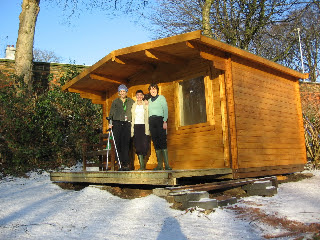
“There were a worrying few months when, with the credit crunch, cabin prices soared but as Autumn came the cabins we'd been looking at on the Internet went on Sale and we decided to buy then even though we hadn't raised the whole amount. We picked the fully insulated version of a timber cabin, with double doors and a window....looking very like a Swiss chalet! (see photo!) Sona and Moksapriya quoted us for installing it. They had a free week in December - and up it went! They both worked long, hard and well as did various members of the community & friends in preparing the site and applying stain and varnish to the finished shed. Amitasuri provided the workers with coffee and bagels. She & Dayanandi also took photos from which Vidyamala has made a great film - soon to be available on You Tube!
“I should mention that we received a great boost to our fundraising when Vidyamala and Amitasuri were granted £750 between them from the Abhayaratna Trust to help fund their use of the cabin. This is a new Charity, set up to support Order Members to live a full life in the Sangha in the face of difficulty due to old age, disability and sickness.

“And so, on the 3rd January, four of us, including Vidyamala, set up a simple shrine and meditated in the cabin for the first time. It was such a lovely, clear space to meditate in, just bare wooden floors and walls with views out across the snowy garden to the woods of the Kersal Dale Nature Reserve. It was pretty quiet; a woodpecker knocking loudly on braches above us, some birdsong, a few cars on the road nearby. Later that day, with six of the seven community members able to be present, we performed a dedication ceremony to ritually inaugurate this beautiful new cabin and with it, I think, a new era in the life of Jyotivana Community!”
 “15 months ago it was the dream of the Jyotivana women's community here in Manchester to have a shrineroom where the community could meditate together. Our previous meditation space was an unheated attic accessible only via a loft ladder which ruled out Vidyamala from joining the others due to her back injuries and was unsuitable for Amitasuri in cold weather due to her kidney condition. (In fact several of the rest of us found it rather gruelling in the winter months!) The dripping & splashing from the water tanks in the roofspace was another issue - arguably a spur to deeper concentration but one I wouldn't be sorry to leave behind!
“The house was being used to maximum capacity with 7 in the community so the only solution seemed to be an outdoor shrine room in some sort of log cabin - probably too expensive for us to afford we thought.... But enthusiasm grew for the cabin and we decided to go for it, enlisting the help of the Sangha through fundraising. Munisha had the idea to hold Fundraising Buddhist Film Nights for the Women's Sangha .....and the rest is history... as they say! The first night we ate a delicious curry, dhal & rice and settled down to watch what turned out to be the first of many inspiring and enjoyable films. The majority of the £6500 that we raised to pay for the cabin came via these film evenings through the small and large donations that were received. But as a community we gained far more than the money for the shrineroom as the evenings were so enjoyable and the sense of support for us and our project so dynamic. We enjoyed welcoming everyone to our community and the ensuing 'explosion' of Sangha was quite amazing with between 20 - 30 women chatting away over dinner and settling down on our sofas for the film. The rumour had got about that we had a big screen for the films - which we did - a large white sheet pinned to the curtains, with a PowerPoint projector! It's amazing how we all fitted into the lounge.
“There were a worrying few months when, with the credit crunch, cabin prices soared but as Autumn came the cabins we'd been looking at on the Internet went on Sale and we decided to buy then even though we hadn't raised the whole amount. We picked the fully insulated version of a timber cabin, with double doors and a window....looking very like a Swiss chalet! (see photo!) Sona and Moksapriya quoted us for installing it. They had a free week in December - and up it went! They both worked long, hard and well as did various members of the community & friends in preparing the site and applying stain and varnish to the finished shed. Amitasuri provided the workers with coffee and bagels. She & Dayanandi also took photos from which Vidyamala has made a great film - soon to be available on You Tube!
“I should mention that we received a great boost to our fundraising when Vidyamala and Amitasuri were granted £750 between them from the Abhayaratna Trust to help fund their use of the cabin. This is a new Charity, set up to support Order Members to live a full life in the Sangha in the face of difficulty due to old age, disability and sickness.

Labels: Communities, Manchester, women
Have your say. 0 comments so far.








 rss
rss